Bridge and Tunnel Club Blog Home
Bridge and Tunnel Club Blog

It’s Turkey Time

Jed Perl’s Worst Nightmare — thousands of pedestrian art consumers “experiencing” the Gates — is happening as I type this.

At the press conference with the mayor yesterday, Christo came close — this close — to explaining his intentions behind the project:

Asked often yesterday to explain the meaning of the project, Christo and Jeanne-Claude emphasized that its meaning would have to be found by those who walked through the 7,500 gates, spread over 23 miles of walkways.

“It has no purpose,” Jeanne-Claude said. “It is not a symbol. It is not a message. It is only a work of art.”

But Christo explained that it related in some ways to the unrealized plans of Frederick Law Olmsted and Calvert Vaux, the park’s designers, to place iron gates at many of the entrances to the park. He added that the fabric panels, which will blow and curve in the wind, are also meant to remind viewers of the park’s serpentine paths and the curves of the empty branches of the trees above them.

After answering several questions, however, Christo became clearly frustrated by trying to explain his work and emphatically urged experience over rational inquiry. “This project is not involved with talk,” he said. “It is real physical space. You need to spend time walking in the cold air – sunny day, rainy day, even snow. It is not necessary to talk.”

Enough talk! Time to go see the things!

Posted: February 12th, 2005 | Filed under: Arts & Entertainment, Manhattan

Bah Freakin’ Humbug

The New Republic’s Jed Perl sounds like that cranky 81-year-old the Post interviewed the other day:

If Christo and Jeanne-Claude did not exist, somebody would have to invent them. The husband-and-wife team whose latest project, “The Gates,” opens in New York’s Central Park on Saturday, are the hardworking, irrepressible promoters of a series of avant-garde-meets-pop-culture happenings that sweep people right off their feet. This fusion phenomenon, with its mix of modernist obscurantism and feel-good communalism, is bohemianism for the masses. There isn’t much of anything left once you’ve stripped these fun-with-fabric extravaganzas of all their logistical complexities. But the sheer bravado of Christo and Jeanne-Claude–who have wrapped buildings and coastlines–can pass for visionary power right now, when so many people are unclear as to where cultural experiences end and life-style choices begin. The acres of saffron cloth that Christo and Jeanne-Claude are unfurling across Central Park are a fashion statement, nothing more. It’s public art for the cocooning generation. It’s aestheticism lite.

Lord, with all that is pretentious in this world we need not gratuitously kiss artist ass, but I do think there’s a little more to the Gates than Perl lets on — fawning crowds and sycophantic volunteers aside. At least I think so! But lest I be equivocal, I should really check in with Herbert Muschamp first — he’s not dead, is he? (Joking! Joking!)

At any rate, Perl questions the Wrapping Wonders’ public art cred:

What fascinates people about Christo and Jeanne-Claude is not only the sensational scale on which they work. It’s also the way that they mix private enterprise and public spiritedness. By now everybody knows that this dynamic duo accepts no public funds. They’re dreamers with entrepreneurial gumption. Speaking to a group of volunteers the other day, Jeanne-Claude told them what to say when people asked about the purpose of “The Gates.” “It’s for nothing,” she explained, as if she were some prophetess of art-for-art’s-sake. “It’s only a work of art. Nothing more.” Well, that sounds very nice. Except that New York City would not be hosting “The Gates” if the Mayor didn’t think it would be a boon to tourism. And the people who are coming from near and far to get in on the action are precisely looking for something more than a work of art–they’re looking for a community, a spectacle, a happening. Of course that desire to experience art with others goes back very far. It’s true that the magic of a masterwork such as Bernini’s Four Rivers fountain in the Piazza Navona in Rome has everything to do with our hankering for community, for spectacle. But with Christo and Jeanne-Claude the experience has no core, no essence. All we get is some fabric flapping in the wind. These artists tap into the yen for art. And the yen seems to be enough.

Got that? It wouldn’t be happening if New York didn’t want more tourism. Well no shit, dude. And I’ll clue you in to one more bit of crass commercialism: it wouldn’t be happening if Christo and Jeanne-Claude didn’t also donate a buttload of money to the Central Park Conservancy. But that’s obviously beside the point — from an aesthetic point of view at least.

You may have noticed where he’s going with it. It’s not New York City’s fault — they just want the revenue. It’s not Christo and Jeanne-Claude’s fault — they just want to promote themselves. If I’m reading him correctly, it’s the public’s fault, for mindlessly flocking to such frippery. Read on — and for fun, substitute “Phish” or “The Grateful Dead” in the appropriate places:

The people who wander through Central Park taking in “The Gates” are going to have an experience, no question about it. They’re going to be in the midst of one of the world’s most beautiful urban spaces. They’re going to find themselves easily striking up conversations with other visitors, which can be fun. They’re going to enjoy the orange fabric billowing in the breeze, and the patterns of bare trees, and the thrilling sense of the booming city all around. And the more that visitors experience all of this, the more that everybody is going to become convinced that what they’re experiencing is great. For Christo and Jeanne-Claude this sort of communal experience may double as an art-for-art’s-sake experience. But just because you’re being bombarded by sensations doesn’t mean that you’re in the presence of major art–or even of mediocre art. When all feelings are regarded as aesthetic experiences, art is at risk. What Christo and Jeanne-Claude have brought to New York is their own brand of late-modern philistinism.

Like I said, bah freakin’ humbug!

There is an out here, of course: Perl could admit that Christo and Jeanne-Claude’s DIY aesthetic (see Fugazi, for example) doesn’t jive with the art world, where anyone who is anyone is represented by a gallery; Christo and Jeanne-Claude represent themselves. (Keep that in mind when you read critics in the next couple of days.)

Look, it’s possible this is going to suck — and I don’t care one iota if it does — but isn’t it possible to at least dig a little deeper than this? I mean, they’re starting to sound like the National Review! (Ooh . . . low blow!)

Big thanks to Ryan at The Side of the Slant for passing this along . . .

Posted: February 11th, 2005 | Filed under: Arts & Entertainment, Manhattan

The Economic Engine of Central Park West

The Times reports that Christo and Jeanne-Claude’s Gates project has spurred a gaggle of cocktail parties in the apartments overlooking the park:

“Everybody I know who lives around the park is doing parties for ‘The Gates,’ said Annaliese Soros, who is planning two parties in her apartment on Central Park West. “The Christo events are happenings, and they attract a lot of enthusiasm. They attract a lot of people. They do something very special and very different. Berlin had five million tourists when he draped the Reichstag. We won’t have that many here.”

She meant in the city, not in her apartment. But some party-givers say the crowd they are expecting is bigger than they had originally planned. The guest list grew as friends called, and friends of friends and friends of friends of friends.

. . .

Donna Rosen, who lives on the 43rd floor of a building a couple of blocks south of Mrs. Soros’s, recalled her conversations with her caterer, Gretchen Aquanita, as they planned an open house in Mrs. Rosen’s apartment. “I said, ‘I think 75,’ ” Mrs. Rosen said. “Then I called again, ‘I think we might be over 100.’ Then I called, ‘200.’ She said, ‘Ahhgggh.’ ”

As the gates were being set in place beneath Mrs. Rosen’s floor-to-ceiling windows on Wednesday, the count was up to 240, and she was talking about Ms. Aquanita’s plans for a menu to match the orange color of the fabric-covered gates on the park’s pedestrian paths.

“She said, ‘Shall we use saffron?’ ” Mrs. Rosen recalled. “I said, ‘Of course.’ ” Ms. Aquanita began planning shrimp and saffron salad.

Meanwhile, Art Historians took note of what was happening:

For some, just looking out the window was not enough to make sure they had a clear view. “I walked over to the park to make sure that I could see the two windows of my apartment,” said Rosamond Ivey, a trustee of the Art Gallery of Ontario, who is giving a “Gates” cocktail party in her apartment on East 79th Street between Madison Avenue and Park Avenue late next week.

Her guests will have drinks at her apartment after inspecting “The Gates” on a walk through the park. Then they will go to the Metropolitan Museum of Art for dinner, where David Moos, the curator of contemporary art at the Ontario museum, will be joined by Jonathan Feinberg, an art historian who wrote a monograph on “The Gates.”

Mr. Moos, whose museum has a Christo exhibition on display, said he is looking forward to seeing “The Gates” from ground level and from Ms. Ivey’s apartment.

“If you think of Central Park as the great democratic American space, Jeffersonian, Whitmanic, in the heart of the metropolis, it is interesting to contemplate who has access to the aerial view,” he said. “It puts into relief this political dimension.”

Whitmania aside, isn’t the point of the article “contemplating who has access to the aerial view?” Are art historians that dumb, or are writers just that obvious?

Speaking of great democratic spaces, if anyone still believes that Central Park was intended to be one, this is basically a perfect explanation why this is not the case. Though I suppose contintuing to hold out that illusion is attractive — in a purely Whitmanic way, of course.

Posted: February 11th, 2005 | Filed under: Arts & Entertainment, Manhattan

L’Horreur! L’Horreur!

Leave it to Adam Gopnik to show how the new, larger, easier-to-read street signs being installed around town are threatening New York’s aesthetic existence:

New Yorkers returning home after the Republican Convention last summer were startled and alarmed by an inexplicable new sight: oversized street signs hanging above busy intersections all over town. It has been five months now, and regrettably, unlike the Republicans, the new signs apparently are not going to go back where they came from.

The signs, if you have somehow missed them, are long and green with big white letters, like a “thru traffic” sign on the New Jersey Turnpike, and they loom ominously out over the intersections they superintend, suspended from the arms of traffic-light poles. They name the street that runs beneath them (and therefore, of course, announce to drivers the street they may want to turn onto), and they do this loudly and with unfortunate abbreviations. Over the intersection of Park Avenue and Eighty-sixth Street, for instance, there is now a long green sign proclaiming “Park Av,” with no period. A couple of blocks east, it gets worse: the green sign rubbernecks its way out into the middle of the street and announces “3Av.” This keeps up (2Av, 1Av) until 86St runs, at last, into East End Av.

The worst thing about reading Adam Gopnik is that it sure doesn’t sound like he’s kidding:

The new signs put you immediately in mind of those nightmarish car trips in Los Angeles, where you begin somewhere and, forty-five minutes later, you are somewhere else, and all the while you have been looking for a big sign that reads “Pico.” Worse than merely unfamiliar, though, the signs are infuriating—first, because they are there for the convenience of cars, and thus violate the first Law of Civilization, which states that nothing must ever be done for the convenience of cars (the mark of a city worth living in is that there are never enough places to park); and, second, because they eclipse, as décor, the jaunty, jazz-era syncopation of the classic New York street-corner sign pair, each sign gesturing toward its own street, but with the two set at slightly different levels, so that they have a happy, semaphoric panache. (The two smaller signs are still there, but they are now drowned out by the highway signage, two jazz piccolos trying to be heard above an electrified kazoo.)

Let it be said that Iris Weinshall, the city’s Commissioner of Transportation, speaks up eloquently and staunchly for the new signs: “They are there for all the multiple users in the city—for motorists, for pedestrians, for people who ride on buses. Many people were finding it harder and harder to read those little old signs we have up. For those evil motorists some people don’t like—now, at least, they have time to make decisions.” She went on, “I like the way the signs look, but it’s a safety issue first of all. The more information you give people, the less likely they are to make silly choices.”

But how many silly (i.e., dangerous) choices were actually encouraged by the old signs? No one has ever bombed along Eighty-sixth Street in blind despair, unable to find Madison Avenue. The new signs signal a choice that is not so much silly as dispiriting. They do more than contribute to the ongoing homogenization, the Americanization, of New York. They imply that the homogenization has already taken place. The reason these kinds of signs are necessary at the intersections of Los Angeles boulevards is that all the avenues and streets there look more or less alike. In New York, each avenue should be, and is, instantly recognizable. Park Avenue looks like Park Avenue; Madison Avenue looks like Madison; Broadway looks like nothing on earth but Broadway. You see the street, and you make the turn. New York is not a hard place to get around in. If you don’t know where you are, you don’t deserve to be here.

Look, are the new signs pretty? No. But as someone who values traffic safety even at the risk of disturbing a “happy, semaphoric panache,” I have to say (with all due respect to a very, very talented writer), “Please, for the love of God, shut the fuck up, you pretentious hack.”

Posted: February 10th, 2005 | Filed under: Architecture & Infrastructure, Sliding Into The Abyss Of Elitism & Pretentiousness

Florist vs. Bodega

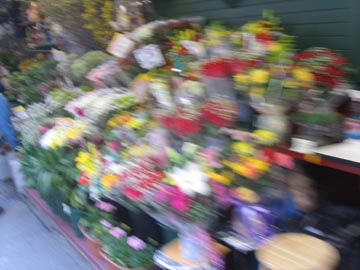
The Daily News tackles the age-old question whether florists can match bodedgas in quality of flowers. The answer may surprise you! “The price of love: Florists’ roses go nose-to-nose vs. bodega bargains”:

Over the next few days, thousands of New York men will be faced with a thorny choice: florist or bodega.

As they head home to their honey on Valentine’s Day, they could find a nice flower shop and pick up a dozen long-stemmed roses for about $50.

But many of those men will be tempted to just drop by the corner grocery and buy a bouquet of the red blossoms for a third or less of that price.

After all, a rose is a rose is a rose, right? And it’s not like the love of their life will be able to tell the difference. Right?

Not so fast, Romeo.

An informal survey by the Daily News found that with a glance and sniff, four out of six women can distinguish the cher from the cheap.

Bodega Flowers . . . Or Not? (East 51st Street, Midtown)

Posted: February 10th, 2005 | Filed under: Consumer Issues
L’Horreur! L’Horreur! »
« Gates Update: Raising the Gates
« Older Entries
Newer Entries »

Recent Posts

  • Text EPIGRAPH To 42069
  • Everyone Is Housed On Stolen Land
  • Speedrun 1975!
  • The Department Of Homeless Turndown Service
  • It Only Took 18 Hours And Perhaps As Many Drafts To Allow That “Some People Did Something”

Categories

Bookmarks

  • 1010 WINS
  • 7online.com (WABC 7)
  • AM New York
  • Aramica
  • Bronx Times Reporter
  • Brooklyn Eagle
  • Brooklyn View
  • Canarsie Courier
  • Catholic New York
  • Chelsea Now
  • City Hall News
  • City Limits
  • Columbia Spectator
  • Courier-Life Publications
  • CW11 New York (WPIX 11)
  • Downtown Express
  • Gay City News
  • Gotham Gazette
  • Haitian Times
  • Highbridge Horizon
  • Inner City Press
  • Metro New York
  • Mount Hope Monitor
  • My 9 (WWOR 9)
  • MyFox New York (WNYW 5)
  • New York Amsterdam News
  • New York Beacon
  • New York Carib News
  • New York Daily News
  • New York Magazine
  • New York Observer
  • New York Post
  • New York Press
  • New York Sun
  • New York Times City Room
  • New Yorker
  • Newsday
  • Norwood News
  • NY1
  • NY1 In The Papers
  • Our Time Press
  • Pat’s Papers
  • Queens Chronicle
  • Queens Courier
  • Queens Gazette
  • Queens Ledger
  • Queens Tribune
  • Riverdale Press
  • SoHo Journal
  • Southeast Queens Press
  • Staten Island Advance
  • The Blue and White (Columbia)
  • The Brooklyn Paper
  • The Columbia Journalist
  • The Commentator (Yeshiva University)
  • The Excelsior (Brooklyn College)
  • The Graduate Voice (Baruch College)
  • The Greenwich Village Gazette
  • The Hunter Word
  • The Jewish Daily Forward
  • The Jewish Week
  • The Knight News (Queens College)
  • The New York Blade
  • The New York Times
  • The Pace Press
  • The Ticker (Baruch College)
  • The Torch (St. John’s University)
  • The Tribeca Trib
  • The Villager
  • The Wave of Long Island
  • Thirteen/WNET
  • ThriveNYC
  • Time Out New York
  • Times Ledger
  • Times Newsweekly of Queens and Brooklyn
  • Village Voice
  • Washington Square News
  • WCBS880
  • WCBSTV.com (WCBS 2)
  • WNBC 4
  • WNYC
  • Yeshiva University Observer

Archives

RSS Feed

  • Bridge and Tunnel Club Blog RSS Feed

@batclub

Tweets by @batclub

Contact

  • Back To Bridge and Tunnel Club Home
    info -at- bridgeandtunnelclub.com

BATC Main Page

  • Bridge and Tunnel Club

2026 | Bridge and Tunnel Club Blog