Bridge and Tunnel Club Blog Home
Bridge and Tunnel Club Blog

A $1200 Cardboard Tube

The dissemination of Gates-related memorabilia on EBay has begun:

Sometimes a cardboard tube is just a cardboard tube. But sometimes, as a New York teenager discovered this week, a cardboard tube might be an objet d’art worth $1,200 – to the right buyer.

Last Saturday, Dane Kolomatsky, 15, accompanied his mother and a friend of hers to Central Park to view “The Gates,” the public artwork created by Christo and his wife, Jeanne-Claude, and composed of 7,500 saffron-colored nylon curtains hanging from rectangular frames along the pathways of the park.

Walking by the Loeb Boathouse near 72nd Street, Dane said, he saw a pile of cardboard tubes on the ground. The tubes had served to spool the curtains at the top of the gates. With the curtains unfurled, the tubes were destined to be transported out of the park and recycled.

“I picked out the smallest one, which was seven feet long, and I asked a volunteer if I could have it,” Dane said. “And he said, ‘Yes, but only one.’ ”

It was not until he decided to sell the cardboard tube on eBay, the popular auction Web site, that Mr. Kolomatsky become embroiled in an impassioned debate over New York’s latest artistic extravaganza.

The tube is one of many pieces of Gates detritus to show up on EBay. Other examples include, somewhat ominously, one of the bolts used to hold the gates together.

In the end, the tube owner decided to retain the keepsake.

Posted: February 16th, 2005 | Filed under: Arts & Entertainment, Manhattan

Gilding the Lily With a Bunch of Drapes

Christo and Jeanne-Claude’s The Gates Project opened yesterday in Central Park:

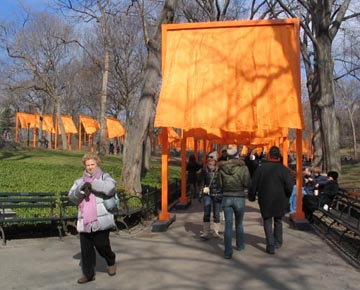
So that is what 1.089 million yards of orange-yellow fabric looks like, floating and fluttering and flapping in Central Park.

The giant $21 million art project “The Gates,” which had already filled the park’s 23 miles of pathways with thousands of saffron-colored portals, blossomed yesterday at 8:31 a.m., just as the artist Christo and his wife, Jeanne-Claude, had planned.

They watched as Mayor Michael R. Bloomberg raised a long metal pole to release fabric from the top of a gate in the Sheep Meadow. Also watching was a crowd that chanted a countdown like the one heard each New Year’s Eve in Times Square – “Five! Four! Three! Two! One!”- before the mayor unfurled the fabric on the first gate.

The Times was on hand to gauge the crowd’s impressions:

By midmorning, the park’s circulatory system had taken on the bright color of veins twisting and twirling against the gray-and-brown backdrop of midwinter. The pleated nylon fabric pulsed and swayed at the whim of a 12-mile-an-hour wind – not strong enough to make it snap like a spinnaker on an America’s Cup challenger. The color was almost as fiery and fierce as the sun that had risen a couple of hours earlier.

“Look at the light,” Christo said. “Look, look.”

In the crowd, people tried to do exactly that. People who had tried to imagine what the completed project would look like finally had a glimpse.

Some described them as too-short window shades dangling in the breeze. Some mentioned squarish out-of-season butterflies. Some were intrigued by the play of light on the fabric: as the peekaboo sun came and went, the nylon had a touchable texture one minute and a one-dimensional look the next. Some echoed what Christo and Jeanne-Claude had said about a river of bright color against twigs and leafless branches. Some talked about exhilaration and exuberance. Some were more literal.

“A pleated skirt,” said Kathleen Catapano of Brooklyn. She looked again, and another idea came to mind: “I think it looks like Jeanne-Claude’s hair.”

We were there so Jed Perl didn’t have to be, and speaking of Jed, The Times’ Michael Kimmelman weighs in, giving a more positive appraisal after having actually seen the Gates:

Thousands of swaths of pleated nylon were unfurled to bob and billow in the breeze. In the winter light, the bright fabric seemed to warm the fields, flickering like a flame against the barren trees. Even at first blush, it was clear that “The Gates” is a work of pure joy, a vast populist spectacle of good will and simple eloquence, the first great public art event of the 21st century. It remains on view for just 16 days. Consider yourself forewarned. Time is fleeting.

On a partly sunny, chilly morning, with helicopters buzzing overhead and mobs of well-wishers on hand, an army of paid helpers gradually released the panels of colored fabric from atop the 16-foot-tall gates, all 7,500 of them. The shifting light couldn’t have been better to show off the effects of the cloth. Sometimes the fabric looked deep orange; at other times it was shiny, like gold leaf, or silvery or almost tan. In the breeze, the skirted gates also appeared to shimmy like dancers in a conga line, the cloth buckling and swaying.

. . .

I hadn’t been quite sure when I first saw the project going up last week. From outside the park, the gates looked like endless rows of inert orange dominoes overwhelming Frederick Law Olmsted’s and Calvert Vaux’s masterpiece.

But as the artists have insisted, the gates aren’t made to be seen from above or from outside. I stopped in at a friend’s office high above Central Park South yesterday and ogled the panorama, which was lovely. But it was beside the point. It’s the difference between sitting in a skybox at Giants Stadium and playing the game on the field. The gates need to be – they are conceived to be – experienced on the ground, at eye level, where, as you move through the park, they crisscross and double up, rising over hills, blocking your view of everything except sky, then passing underfoot, through an underpass, or suddenly appearing through a copse of trees, their fabric fluttering in the corner of your eye.

There are no bad locales for seeing them. But there are some spots at which the work looks best: around the Heckscher ball fields, where the gates are dense and lines of them swarm in many directions at once; at the base of Strawberry Fields, where two parallel rows march in tight syncopation; at Harlem Meer, where they cluster up to the shore and then clamber, helter-skelter, up the rocks. Also at Great Hill, near West 106th Street, where they encircle the crescent field, then descend a flight of steep steps.

And at North Meadow, a wide-open vista, where the gates wander off toward the horizon, separating earth and sky with an undulating saffron band.

And in the end, Kimmelman helps express what Christo and Jeanne-Claude either didn’t want to or couldn’t:

Some purists will complain that the art spoils a sanctuary, that the park is perfect as it is, which it is. But the work, I think, pays gracious homage to Olmsted’s and Vaux’s abiding pastoral vision: like immense Magic Marker lines, the gates highlight the ingenious and whimsical curves, dips and loops that Olmsted and Vaux devised as antidotes to the rigid grid plan of the surrounding city streets and, by extension, to the general hardships of urban life.

The gates, themselves a cure for psychic hardship, remind us how much those paths vary, in width, and height, like the crowds of people who walk along them. More than that, being so sensitive to nature, they make us more sensitive to its effects.

We didn’t need the gates to make us sensitive, obviously. Art is never necessary. It is merely indispensable.

At its best, it leads us toward places we might not have thought to visit. Victor Hugo once said, “There is nothing more interesting than a wall behind which something is happening.” This also applies to gates, which beckon people to discover what is beyond them.

With their endless self-promotion, and followers trailing them like Deadheads from one global gig to another, it’s no wonder that Christo and Jeanne-Claude have made a few skeptics of people who often have not seen their art at first hand. New Yorkers are a notoriously tough crowd. But I was struck by what I overheard a stranger say. She was a doubter won over yesterday. “It will be fascinating when they’re gone,” she mused.

It took me a second to realize what she meant: that the gates, by ravishing the eye, have already impressed an image of the park on the memories of everyone who has seen them. And like all vivid memories, that image can take a place in the imagination, like a smell or some notes of music or a breeze, waiting to be rekindled.

Once upon a time there were “The Gates.” The time is now.

I’d like to go back and see some of the spots Kimmelman suggested — parts of the project look great, especially from the vantage point of one of the park’s rock outcroppings. And the bright orange (sorry, saffron) looks stunning against a clear blue sky. When there’s a wind, as there was yesterday, the effect of the fabric twisting in the wind is beautiful, but I have to agree with one of the people the Times quoted that when they hang there they sort of look like big drapes. In all, I liked it, though I can see what curmudgeons dislike about the whole enterprise.

One small quibble: the path we took — from 59th and Fifth to Belvedere Castle via the Mall and the Ramble — was, if memory serves, the way Olmsted and Vaux intended the parkgoer to move through, back through nature, as it were. I think Christo and Jeanne-Claude could have done a little more with that idea, though like I said, parts of the project are stunning as they are.

The Post’s coverage highlights a near calamity (“Adding a bit of chaos to the process, as the fabric was unfurled, the cardboard tube it was wrapped around crashed to the ground, sending spectators running and causing a few minor injuries. Bloomberg got bonked on the head by a falling tube. He wasn’t hurt, but elsewhere a man had his glasses shattered and a woman suffered a bloody nose.”) and also features another one of those crabby elderly people — do they actually exist? — who object to everything:

Not everyone was taken by the project’s siren song.

“They deface the park. Why gild the lily? This is the most beautiful park in the entire world,” one elderly man screamed at a woman as she described how much she liked the work.

“You know, art is supposed to provoke controversy, so I’d say that it worked,” the woman, Barbara Peabody, shot back, sending the man storming off.

See also: Daily News coverage; Newsday coverage.

Near the 65th Street Transverse, Christo and Jeanne-Claude's Gates Project: Opening Day, February 12, 2005

Posted: February 13th, 2005 | Filed under: Arts & Entertainment, Manhattan

It’s Turkey Time

Jed Perl’s Worst Nightmare — thousands of pedestrian art consumers “experiencing” the Gates — is happening as I type this.

At the press conference with the mayor yesterday, Christo came close — this close — to explaining his intentions behind the project:

Asked often yesterday to explain the meaning of the project, Christo and Jeanne-Claude emphasized that its meaning would have to be found by those who walked through the 7,500 gates, spread over 23 miles of walkways.

“It has no purpose,” Jeanne-Claude said. “It is not a symbol. It is not a message. It is only a work of art.”

But Christo explained that it related in some ways to the unrealized plans of Frederick Law Olmsted and Calvert Vaux, the park’s designers, to place iron gates at many of the entrances to the park. He added that the fabric panels, which will blow and curve in the wind, are also meant to remind viewers of the park’s serpentine paths and the curves of the empty branches of the trees above them.

After answering several questions, however, Christo became clearly frustrated by trying to explain his work and emphatically urged experience over rational inquiry. “This project is not involved with talk,” he said. “It is real physical space. You need to spend time walking in the cold air – sunny day, rainy day, even snow. It is not necessary to talk.”

Enough talk! Time to go see the things!

Posted: February 12th, 2005 | Filed under: Arts & Entertainment, Manhattan

Bah Freakin’ Humbug

The New Republic’s Jed Perl sounds like that cranky 81-year-old the Post interviewed the other day:

If Christo and Jeanne-Claude did not exist, somebody would have to invent them. The husband-and-wife team whose latest project, “The Gates,” opens in New York’s Central Park on Saturday, are the hardworking, irrepressible promoters of a series of avant-garde-meets-pop-culture happenings that sweep people right off their feet. This fusion phenomenon, with its mix of modernist obscurantism and feel-good communalism, is bohemianism for the masses. There isn’t much of anything left once you’ve stripped these fun-with-fabric extravaganzas of all their logistical complexities. But the sheer bravado of Christo and Jeanne-Claude–who have wrapped buildings and coastlines–can pass for visionary power right now, when so many people are unclear as to where cultural experiences end and life-style choices begin. The acres of saffron cloth that Christo and Jeanne-Claude are unfurling across Central Park are a fashion statement, nothing more. It’s public art for the cocooning generation. It’s aestheticism lite.

Lord, with all that is pretentious in this world we need not gratuitously kiss artist ass, but I do think there’s a little more to the Gates than Perl lets on — fawning crowds and sycophantic volunteers aside. At least I think so! But lest I be equivocal, I should really check in with Herbert Muschamp first — he’s not dead, is he? (Joking! Joking!)

At any rate, Perl questions the Wrapping Wonders’ public art cred:

What fascinates people about Christo and Jeanne-Claude is not only the sensational scale on which they work. It’s also the way that they mix private enterprise and public spiritedness. By now everybody knows that this dynamic duo accepts no public funds. They’re dreamers with entrepreneurial gumption. Speaking to a group of volunteers the other day, Jeanne-Claude told them what to say when people asked about the purpose of “The Gates.” “It’s for nothing,” she explained, as if she were some prophetess of art-for-art’s-sake. “It’s only a work of art. Nothing more.” Well, that sounds very nice. Except that New York City would not be hosting “The Gates” if the Mayor didn’t think it would be a boon to tourism. And the people who are coming from near and far to get in on the action are precisely looking for something more than a work of art–they’re looking for a community, a spectacle, a happening. Of course that desire to experience art with others goes back very far. It’s true that the magic of a masterwork such as Bernini’s Four Rivers fountain in the Piazza Navona in Rome has everything to do with our hankering for community, for spectacle. But with Christo and Jeanne-Claude the experience has no core, no essence. All we get is some fabric flapping in the wind. These artists tap into the yen for art. And the yen seems to be enough.

Got that? It wouldn’t be happening if New York didn’t want more tourism. Well no shit, dude. And I’ll clue you in to one more bit of crass commercialism: it wouldn’t be happening if Christo and Jeanne-Claude didn’t also donate a buttload of money to the Central Park Conservancy. But that’s obviously beside the point — from an aesthetic point of view at least.

You may have noticed where he’s going with it. It’s not New York City’s fault — they just want the revenue. It’s not Christo and Jeanne-Claude’s fault — they just want to promote themselves. If I’m reading him correctly, it’s the public’s fault, for mindlessly flocking to such frippery. Read on — and for fun, substitute “Phish” or “The Grateful Dead” in the appropriate places:

The people who wander through Central Park taking in “The Gates” are going to have an experience, no question about it. They’re going to be in the midst of one of the world’s most beautiful urban spaces. They’re going to find themselves easily striking up conversations with other visitors, which can be fun. They’re going to enjoy the orange fabric billowing in the breeze, and the patterns of bare trees, and the thrilling sense of the booming city all around. And the more that visitors experience all of this, the more that everybody is going to become convinced that what they’re experiencing is great. For Christo and Jeanne-Claude this sort of communal experience may double as an art-for-art’s-sake experience. But just because you’re being bombarded by sensations doesn’t mean that you’re in the presence of major art–or even of mediocre art. When all feelings are regarded as aesthetic experiences, art is at risk. What Christo and Jeanne-Claude have brought to New York is their own brand of late-modern philistinism.

Like I said, bah freakin’ humbug!

There is an out here, of course: Perl could admit that Christo and Jeanne-Claude’s DIY aesthetic (see Fugazi, for example) doesn’t jive with the art world, where anyone who is anyone is represented by a gallery; Christo and Jeanne-Claude represent themselves. (Keep that in mind when you read critics in the next couple of days.)

Look, it’s possible this is going to suck — and I don’t care one iota if it does — but isn’t it possible to at least dig a little deeper than this? I mean, they’re starting to sound like the National Review! (Ooh . . . low blow!)

Big thanks to Ryan at The Side of the Slant for passing this along . . .

Posted: February 11th, 2005 | Filed under: Arts & Entertainment, Manhattan

The Economic Engine of Central Park West

The Times reports that Christo and Jeanne-Claude’s Gates project has spurred a gaggle of cocktail parties in the apartments overlooking the park:

“Everybody I know who lives around the park is doing parties for ‘The Gates,’ said Annaliese Soros, who is planning two parties in her apartment on Central Park West. “The Christo events are happenings, and they attract a lot of enthusiasm. They attract a lot of people. They do something very special and very different. Berlin had five million tourists when he draped the Reichstag. We won’t have that many here.”

She meant in the city, not in her apartment. But some party-givers say the crowd they are expecting is bigger than they had originally planned. The guest list grew as friends called, and friends of friends and friends of friends of friends.

. . .

Donna Rosen, who lives on the 43rd floor of a building a couple of blocks south of Mrs. Soros’s, recalled her conversations with her caterer, Gretchen Aquanita, as they planned an open house in Mrs. Rosen’s apartment. “I said, ‘I think 75,’ ” Mrs. Rosen said. “Then I called again, ‘I think we might be over 100.’ Then I called, ‘200.’ She said, ‘Ahhgggh.’ ”

As the gates were being set in place beneath Mrs. Rosen’s floor-to-ceiling windows on Wednesday, the count was up to 240, and she was talking about Ms. Aquanita’s plans for a menu to match the orange color of the fabric-covered gates on the park’s pedestrian paths.

“She said, ‘Shall we use saffron?’ ” Mrs. Rosen recalled. “I said, ‘Of course.’ ” Ms. Aquanita began planning shrimp and saffron salad.

Meanwhile, Art Historians took note of what was happening:

For some, just looking out the window was not enough to make sure they had a clear view. “I walked over to the park to make sure that I could see the two windows of my apartment,” said Rosamond Ivey, a trustee of the Art Gallery of Ontario, who is giving a “Gates” cocktail party in her apartment on East 79th Street between Madison Avenue and Park Avenue late next week.

Her guests will have drinks at her apartment after inspecting “The Gates” on a walk through the park. Then they will go to the Metropolitan Museum of Art for dinner, where David Moos, the curator of contemporary art at the Ontario museum, will be joined by Jonathan Feinberg, an art historian who wrote a monograph on “The Gates.”

Mr. Moos, whose museum has a Christo exhibition on display, said he is looking forward to seeing “The Gates” from ground level and from Ms. Ivey’s apartment.

“If you think of Central Park as the great democratic American space, Jeffersonian, Whitmanic, in the heart of the metropolis, it is interesting to contemplate who has access to the aerial view,” he said. “It puts into relief this political dimension.”

Whitmania aside, isn’t the point of the article “contemplating who has access to the aerial view?” Are art historians that dumb, or are writers just that obvious?

Speaking of great democratic spaces, if anyone still believes that Central Park was intended to be one, this is basically a perfect explanation why this is not the case. Though I suppose contintuing to hold out that illusion is attractive — in a purely Whitmanic way, of course.

Posted: February 11th, 2005 | Filed under: Arts & Entertainment, Manhattan
Bah Freakin’ Humbug »
« L’Horreur! L’Horreur!
« Older Entries
Newer Entries »

Recent Posts

  • “Friends And Allies Literally Roll Their Eyes When They Hear The New York City Mayor Is Trying To Go National Again”
  • You Don’t Achieve All Those Things Without Managing The Hell Out Of The Situation
  • “Less Than Six Months After Bill De Blasio Became Mayor Of New York City, A Campaign Donor Buttonholed Him At An Event In Manhattan”
  • Nothing Hamburger
  • On Cheap Symbolism

Categories

Bookmarks

  • 1010 WINS
  • 7online.com (WABC 7)
  • AM New York
  • Aramica
  • Bronx Times Reporter
  • Brooklyn Eagle
  • Brooklyn View
  • Canarsie Courier
  • Catholic New York
  • Chelsea Now
  • City Hall News
  • City Limits
  • Columbia Spectator
  • Courier-Life Publications
  • CW11 New York (WPIX 11)
  • Downtown Express
  • Gay City News
  • Gotham Gazette
  • Haitian Times
  • Highbridge Horizon
  • Inner City Press
  • Metro New York
  • Mount Hope Monitor
  • My 9 (WWOR 9)
  • MyFox New York (WNYW 5)
  • New York Amsterdam News
  • New York Beacon
  • New York Carib News
  • New York Daily News
  • New York Magazine
  • New York Observer
  • New York Post
  • New York Press
  • New York Sun
  • New York Times City Room
  • New Yorker
  • Newsday
  • Norwood News
  • NY1
  • NY1 In The Papers
  • Our Time Press
  • Pat’s Papers
  • Queens Chronicle
  • Queens Courier
  • Queens Gazette
  • Queens Ledger
  • Queens Tribune
  • Riverdale Press
  • SoHo Journal
  • Southeast Queens Press
  • Staten Island Advance
  • The Blue and White (Columbia)
  • The Brooklyn Paper
  • The Columbia Journalist
  • The Commentator (Yeshiva University)
  • The Excelsior (Brooklyn College)
  • The Graduate Voice (Baruch College)
  • The Greenwich Village Gazette
  • The Hunter Word
  • The Jewish Daily Forward
  • The Jewish Week
  • The Knight News (Queens College)
  • The New York Blade
  • The New York Times
  • The Pace Press
  • The Ticker (Baruch College)
  • The Torch (St. John’s University)
  • The Tribeca Trib
  • The Villager
  • The Wave of Long Island
  • Thirteen/WNET
  • ThriveNYC
  • Time Out New York
  • Times Ledger
  • Times Newsweekly of Queens and Brooklyn
  • Village Voice
  • Washington Square News
  • WCBS880
  • WCBSTV.com (WCBS 2)
  • WNBC 4
  • WNYC
  • Yeshiva University Observer

Archives

RSS Feed

  • Bridge and Tunnel Club Blog RSS Feed

@batclub

Tweets by @batclub

Contact

  • Back To Bridge and Tunnel Club Home
    info -at- bridgeandtunnelclub.com

BATC Main Page

  • Bridge and Tunnel Club

2025 | Bridge and Tunnel Club Blog