Bridge and Tunnel Club Blog Home
Bridge and Tunnel Club Blog

Unibrow for the Working Class

Story by story, bit by bit, those effete elitists at the Times are dismantling the myth of the working man. “Tough Guys, Shapely Eyebrows”:

In a quiet revolution sweeping the blue-collar precincts of metropolitan New York, mechanics, firemen and construction workers – most of them insistently heterosexual – are unapologetically doting on their eyebrows. Inspired by “Queer Eye for the Straight Guy” and the well-coiffed rap artists on BET, cowed by tweezers-wielding girlfriends and goaded by wisecracking co-workers, they are plucking and waxing as never before. And they don’t lie about it.

“Eyebrows were the last frontier,” said Louis DeJesus, a hair stylist whose Bronx salon, International Nails and Beauty, started seeing an influx of men about two years ago. “Everyone’s doing it now. And once a guy starts doing it, he gets addicted.”

. . .

From the immigrant enclaves of Queens to the minimalls of Long Island, modest salons that once catered to women find themselves inundated by primping, preening men, most of them young working-class guys who tend to spend their weekends at dance clubs. Even the Gotti brothers, the ones with their own reality television show, have embraced a minimalist approach to facial hair.

Carol Cedeno, a manicurist at Tom’s Scissorhands, a salon in Paterson, N.J., has seen the trend. “A lot of the guys used to be embarrassed, but now they just walk in and say it proudly: ‘I want my eyebrows done,’ ” she said, noting that her salon offers a wax job for $5. “Sometimes their eyebrows end up looking more dainty than their girlfriends’.”

When he first started tweezing last year, Al Bernal, a 31-year-old auto mechanic from Newark, said his friends called his sexuality into question. “They said I looked, you know, gay,” said Mr. Bernal, whose style is maintained by his fiancée. “Of course, these days they do it, too, and they love it because they get a lot more attention from chicks.”

Unintentionally adopting a look that got its start in gay clubs, Mr. Bernal and his friends – who once aspired to the roughneck street thug look – have also discovered the allure of the year-round tan, the shaved chest and the eye-catching clubbing outfit. Diamond studs are in. Flashy gold chains are out. Guys, without even a pause, call it “the pretty-boy look.”

Robbie Wootton, the owner of Spirit, a Chelsea nightclub that caters to the bridge-and-tunnel set on Saturday nights, says the transformation has been stunning. “Never mind the eyebrows,” he said. “These guys shave their whole bodies, even their arms. If you bump up against them in the early morning you can feel the stubble growing back. It’s like rubbing sandpaper.”

Posted: December 31st, 2004 | Filed under: Cultural-Anthropological, The New York Times

“Nature Must Not Win the Game”

The Times, doing a fancy-pants version of that Jay Leno “Jay Walking” thing, asks subway riders what the cryptic quotes in the subway station under Bryant Park mean. Hilarity ensues:

In the subway there is a riddle disguised as a declaration. It is engraved in gray stone on a wall of the station at 42nd Street and Avenue of the Americas, atop a staircase to the platform where the B, the D, the F and the V rumble by.

“Nature must not win the game,” the inscription reads, “but she cannot lose.” Each day the words float briefly before thousands of eyes. A few riders pause to ponder them as they go on their way, perhaps seeking a clue in the backdrop, a mosaic of what look like berry-bearing vines creeping through and eating away at the gray stone.

The simple-sounding sentence, the inscription says, was written by Carl G. Jung, the psychologist and mythographer. What does it signify? And what is it doing in the subway?

Who knows? Not Joe Noto.

“Honestly, I couldn’t tell you what it means,” Mr. Noto, an electrician on his way home to Dyker Heights, Brooklyn, said the other day. Many other riders refused even to entertain the question.

Of course, this is New York, so no Jay Walking here:

But two recent afternoons spent conducting a semi-random survey turned up a fair share of subterranean philosophers intrigued by the cryptic pronouncement, which has been on the wall since 2002. Was it meant as a reassurance or a warning? Is it a good thing if nature wins, or a bad thing?

A police officer patrolling the station, Officer Russell King of Transit District 1, which includes the 42nd Street station, has worked enough slow shifts to have had time to chew over Jung’s words. “It seems like he’s an urbanite,” Officer King said. “It seems like we as a people in this city have to overcome everything to live.” But, he added, there’s a twist: we are part of nature, so if we defeat nature, we defeat ourselves. “It’s like a double negative, a Catch-22,” he said. “If we win, we lose.” Officer King’s partner on patrol, Wayne Steele, picked up the riff. “No matter what,” said Officer Steele, a beefy man with a prominent mustache, “nature’s going to win.”

Some people tried to break the sentence into its parts.

“‘Nature must not win,'” repeated an unassuming man in a blue-and-red windbreaker, who said he was a designer of women’s accessories and volunteered only his first name, Emilio, and his home country, Ecuador. “So man – man could win?” Emilio asked. “I think nature is bigger than man. At first glance, it makes me think two things. One is the grabs for a global empire – the power of the big corporations trying to run the world.”

A southbound F train pulled in and Emilio got on. “But beyond the greed itself,” he continued, “unless the people can make decisions in the world, it’s much easier to do just a few people’s interests.”

The train stopped at 34th Street. Emilio got out. “Nature,” he said. “Who controls nature? Nature is God. It’s the fight between the power of man’s greed and the power of God. And when it comes to reality, it doesn’t matter how much money you have, you can’t control the world.” He disappeared through the turnstiles.

But just so you know, some riders — not unsmart ones, we! — told the Times that the installation just makes them feel stupid:

“I don’t like it,” said Martin Bernier, a transplanted Parisian who owns a wholesale bakery in Queens. “I don’t think it’s appropriate for people to see in the subway. Why do they put this here? Who is Carl Gustav Jung? I know who he is now because I made a small investigation. But it makes me feel ignorant.”

Mr. Bernier pointed out that the Jung installation was part of a much larger piece that proceeds down the long corridor to the Fifth Avenue exit and includes quotations from Ovid, the nursery rhyme “Jack and Jill,” and an obscure passage from “Finnegan’s Wake,” each being invaded from above by mosaics of golden tree roots and from below by mosaics of bedrock.

Sipping quickly from his coffee cup, Mr. Bernier, 52, led a reporter down the corridor. “Look at this,” he said. “James Joyce. He’s Irish, right?” The decay hinted at in the mosaics, Mr. Bernier said, assaulted the eye.

“I’m glad to talk about this,” Mr. Bernier confided, “because I was very disturbed by this corridor. I have an average education, and I feel frustrated. It made me feel like an idiot.”

Finally, for the record, an expert’s opinion:

Meredith Sabini, a Jungian psychologist who recently compiled a book of Jung’s writings on nature, “The Earth Has a Soul,” said the quotation referred to a struggle between the conscious and the unconscious, or “natural,” mind.

“Jung is saying we’re not supposed to follow instinct blindly,” Ms. Sabini said in a telephone interview from her office in California. “We’re supposed to have consciousness. But that doesn’t mean you’re supposed to kill nature. Because the unconscious is wisdom that has grown over the millions of years we have been Homo sapiens.”

The full quotation, from Jung’s “Alchemical Studies,” says: “Nature must not win the game, but she cannot lose. And whenever the conscious mind clings to hard and fast concepts and gets caught in its own rules and regulations – as is unavoidable and of the essence of civilized consciousness – nature pops up with her inescapable demands.”

Bonus Point: MTA’s Arts for Transit Pages (curiously, no “Under Bryant Park”).

Posted: December 27th, 2004 | Filed under: Arts & Entertainment, The New York Times

2004 Macy’s Thanksgiving Day Parade

Yesterday was the 2004 Macy’s Thanksgiving Day Parade, which we viewed from the tenth floor of Five Times Square.

The Times surveyed the scene from the street:

Soft mud squashed underfoot, idle breezes wafted into open windows, and an estimated 2.5 million spectators who lined up along Central Park West and Broadway basked in a 64-degree morning that felt more like early May than late November.

After all the hand-wringing that wind gusts might ground the giant, helium-inflated balloons, the parade turned into one of the most placid and postcard-perfect in years.

More of the postcard:

As usual, the Technicolor convoy began creeping through the Upper West Side around 9 a.m. and reached Herald Square around noon. It was led this year by a helmet-wearing Super Grover, the impish Sesame Street character.

Barbie characters sang, and Broadway actors plugged their musicals. Rock-faced marching-band leaders high-stepped by. Celebrities waved. Dancers grinned. Children in the Dakota apartment building pressed against the windows to get a better look.

Even more postcard:

Strangers took photos of one another, posed in front of giant floating turkeys. Kids played catch in the street, families planned afternoon football games, and a homeless man on 72nd Street sipped from a large Starbucks cup.

And last but certainly not least, the signature Times sociological longview:

The parade’s patriotic tone in the years after 9/11 had been subsumed by exultant commercialism.

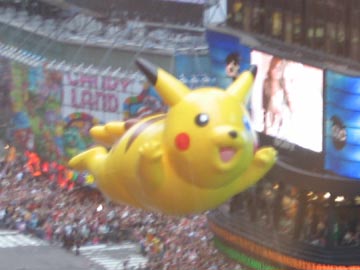
The parade’s 59 balloons included M&M’s candies characters, Ronald McDonald and the game icon Mr. Monopoly. As they floated past, children waved and called out “SpongeBob!” and “Pikachu!” to get the balloons’ attention.

When less-commercial floats and generic turkey and elf balloons passed by, the crowds applauded politely, like parents at a mediocre piano recital.

In all, a day to remember!

Oh, and about that Pikachu thing:

Pikachu, Macy's Thanksgiving Day Parade, November 25, 2004

Posted: November 26th, 2004 | Filed under: Manhattan, The New York Times
New York’s Psyche, Revealed by Metropolitan Diary »
« Amtrak Julie
Newer Entries »

Recent Posts

  • “Friends And Allies Literally Roll Their Eyes When They Hear The New York City Mayor Is Trying To Go National Again”
  • You Don’t Achieve All Those Things Without Managing The Hell Out Of The Situation
  • “Less Than Six Months After Bill De Blasio Became Mayor Of New York City, A Campaign Donor Buttonholed Him At An Event In Manhattan”
  • Nothing Hamburger
  • On Cheap Symbolism

Categories

Bookmarks

  • 1010 WINS
  • 7online.com (WABC 7)
  • AM New York
  • Aramica
  • Bronx Times Reporter
  • Brooklyn Eagle
  • Brooklyn View
  • Canarsie Courier
  • Catholic New York
  • Chelsea Now
  • City Hall News
  • City Limits
  • Columbia Spectator
  • Courier-Life Publications
  • CW11 New York (WPIX 11)
  • Downtown Express
  • Gay City News
  • Gotham Gazette
  • Haitian Times
  • Highbridge Horizon
  • Inner City Press
  • Metro New York
  • Mount Hope Monitor
  • My 9 (WWOR 9)
  • MyFox New York (WNYW 5)
  • New York Amsterdam News
  • New York Beacon
  • New York Carib News
  • New York Daily News
  • New York Magazine
  • New York Observer
  • New York Post
  • New York Press
  • New York Sun
  • New York Times City Room
  • New Yorker
  • Newsday
  • Norwood News
  • NY1
  • NY1 In The Papers
  • Our Time Press
  • Pat’s Papers
  • Queens Chronicle
  • Queens Courier
  • Queens Gazette
  • Queens Ledger
  • Queens Tribune
  • Riverdale Press
  • SoHo Journal
  • Southeast Queens Press
  • Staten Island Advance
  • The Blue and White (Columbia)
  • The Brooklyn Paper
  • The Columbia Journalist
  • The Commentator (Yeshiva University)
  • The Excelsior (Brooklyn College)
  • The Graduate Voice (Baruch College)
  • The Greenwich Village Gazette
  • The Hunter Word
  • The Jewish Daily Forward
  • The Jewish Week
  • The Knight News (Queens College)
  • The New York Blade
  • The New York Times
  • The Pace Press
  • The Ticker (Baruch College)
  • The Torch (St. John’s University)
  • The Tribeca Trib
  • The Villager
  • The Wave of Long Island
  • Thirteen/WNET
  • ThriveNYC
  • Time Out New York
  • Times Ledger
  • Times Newsweekly of Queens and Brooklyn
  • Village Voice
  • Washington Square News
  • WCBS880
  • WCBSTV.com (WCBS 2)
  • WNBC 4
  • WNYC
  • Yeshiva University Observer

Archives

RSS Feed

  • Bridge and Tunnel Club Blog RSS Feed

@batclub

Tweets by @batclub

Contact

  • Back To Bridge and Tunnel Club Home
    info -at- bridgeandtunnelclub.com

BATC Main Page

  • Bridge and Tunnel Club

2025 | Bridge and Tunnel Club Blog