Bridge and Tunnel Club Blog Home
Bridge and Tunnel Club Blog

That Was Some Fire

The Greenpoint waterfront was on fire yesterday, as a 10-alarm blaze burned down part of a historic factory complex, the Greenpoint Terminal Market:

The blaze burned all day as it consumed a former rope factory on West Street near the site of the Continental Iron Works in Greenpoint, which launched the ironclad warship Monitor for the Union 144 years ago. The fire blackened the sky above northern Brooklyn with thick smoke shot through at its base with bright flames a block deep. The plume could be seen for miles.

“It was like a flamethrower,” said John Czaplinski, who lives nearby on Noble Street. “The fire was leaping from one building to another.”

More than 350 firefighters from at least 70 units spent all day at the fire, those in front retreating to safety when entire walls crumbled and launched smoldering red bricks 100 feet down the narrow streets of the waterfront. At 10 alarms, it was called the city’s largest fire in more than a decade, excepting the terrorist attacks of Sept. 11, 2001.

The speed of the blaze and the fact that it started just before dawn in abandoned buildings led investigators to suspect arson, said Fire Commissioner Nicholas Scoppetta. The buildings were owned by Joshua Guttman, of Lawrence, N.Y., a real estate developer with a history of buying commercial properties and turning them into condominiums.

A lawyer for Mr. Guttman, Joseph Kosofsky, said the developer had no idea how the fire began. “It’s the last thing in the world we need right now,” he said. “He’s a very substantial guy. If someone set fire to it, it could have been squatters, it could have been anybody. How in the hell can you watch 21 acres of industrial property?”

. . .

The complex was originally the site of the American Manufacturing Company, built around 1890 initially to make rope and bagging, later manufacturing 10 million pounds of oakum, a jute fiber used in caulking seams on wooden ships, according to the Municipal Art Society. By 1913, the company employed 2,234 workers, many settling nearby in Greenpoint.

. . .

Firefighters fought to keep the flames from jumping West Street, where the buildings were linked by overhead corridors. Shortly after 9:30 a.m., a shower of bricks, plaster and beams crashed onto that street, inches from a parked car. A short while later, the facade of a different wall first buckled, then caved outward, collapsing onto Noble Street.

Commissioner Scoppetta said he expected firefighters to work through the night, followed by the demolition of what remained of the buildings. No one was forced to stay out of their homes, he said.

Mr. Kosofsky rejected any suggestion that Mr. Guttman could have been involved in the blaze. He said the destruction wrought by the fire caused more problems than the demolition Mr. Guttman had planned.

“We can knock it down in a half a day,” Mr. Kosofsky said.

“He is devastated; he is very upset,” Mr. Kosofsky said of Mr. Guttman. “He does not need this aggravation. He had big plans. It is holding him up. He does not need the publicity.”

Councilman David Yassky was on the radio yesterday saying that he was pushing to have the site landmarked.

From Hunters Point, Queens at around 8:00 a.m.:
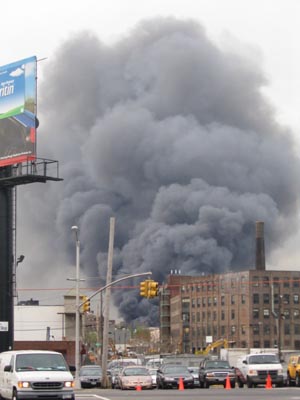
Greenpoint Terminal Market Fire From Vernon Boulevard, Hunters Point Queens, May 3, 2006

Posted: May 3rd, 2006 | Filed under: Brooklyn, Historical, Smells Fishy, Smells Not Right

Jane Jacobs

Urbanist Jane Jacobs passed away in Toronto yesterday:

In 1952, Ms. Jacobs got a job as an editor at Architectural Forum, where she stayed for 10 years. That gave her a perch from which to observe urban renewal projects. On a visit to Philadelphia, she noticed that the streets of a project were deserted while an older, nearby street was crowded.

“So, I got very suspicious of this whole thing,” she told The Toronto Star in 1997. “I pointed that out to the designer, but it was absolutely uninteresting to him. How things worked didn’t interest him.

“He wasn’t concerned about its attractiveness to people. His notion was totally aesthetic, divorced from everything else.”

Her doubts increased after William Kirk, the director of the Union Settlement in East Harlem, taught her new ways of seeing neighborhoods. She came to see the prevalent planning notions, which involved bulldozing low-rise housing in poor neighborhoods and replacing it with tall apartment buildings surrounded by open space, as a superstition akin to early 19th-century physicians’ belief in bloodletting.

“There is a quality even meaner than outright ugliness or disorder,” she wrote in “Death and Life,” “and this meaner quality is the dishonest mask of pretended order, achieved by ignoring or suppressing the real order that is struggling to exist and to be served.”

. . .

Her seemingly simple prescriptions for neighborhood diversity, short blocks, dense populations and a mix of buildings represented a major rethinking of modern planning. They were coupled with fierce condemnations of the writings of the planners Sir Patrick Geddes and Ebenezer Howard, as well as those of the architect Le Corbusier and Lewis Mumford, who championed the ideal of graceful towers rising over exquisite open spaces.

One of the mix of buildings she wrote about was 11th Street between Fifth and Sixth Avenues . . .

For New Yorkers, she lived on in the famous photo of her with a beer and a cigarette in the White Horse Tavern in Greenwich Village . . .

It’s worth noting that she talked a lot about bars in Death and Life of Great American Cities. Although she might have a problem with the glut of bars in, say, the East Village (where community boards are on the hunt — community boards, by the way, being one of Jacobs’ big suggestions in Death and Life), she definitely saw bars as key to a neighborhood’s diversity — something that helps keep neighborhoods lively and safe well into the evening.

The AP obit features this gem:

During the Depression, on days when job hunts went nowhere, she would invest a nickel in the subway and explore a neighborhood: the diamond district, the garment district, the meatpacking district.

This love of exploration is of course the guiding principle behind the Big Map, so we’re indebted to her in this way, too.

(Les Freres Corbusiers get a shout-out, too: “Her most famous confrontation came in the early ’60s, when she helped defeat a plan by New York City park commissioner Robert Moses to build an expressway through Washington Square, their rivalry immortalized in the 2004 play ‘Boozy.'”)

Posted: April 26th, 2006 | Filed under: Historical

Where Are They Now? Setting Wesleyan Records For Hits!

Sadly, anecdotes confirming your assumption that Red Sox fans are the biggest yobbos around are plentiful:

The pitch was a fastball on the outside part of the plate, exactly what Jeffrey Maier was looking for on Wednesday afternoon as Wesleyan University took on Bates College in a relaxed baseball setting that bore no resemblance to Yankee Stadium.

Maier took a left-handed swing and drove the ball into the outfield for a run-scoring double. His Wesleyan teammates cheered, and so did several dozen fans, including his parents and sister. As the umpire tossed the souvenir ball to the bench, Maier stood on second base and tried to keep the smile off his bearded face. For the second time in his life, Maier had made baseball history.

Does the name sound familiar? It might. Ten years ago, when the Yankees met the Baltimore Orioles in the first game of the American League Championship Series, Maier was the 12-year-old boy who reached over the right-field wall for Derek Jeter’s fly ball in the Bronx.

. . .

For years, Maier avoided interviews about the incident, but he was a national story after it occurred. He was from Old Tappan, N.J., and the ticket to the game had been a present at his bar mitzvah, held a week earlier with a World Series theme.

“I didn’t mean to do anything bad,” Maier explained at the time. “I’m just a 12-year-old kid trying to catch a ball.” But other fans were not so understanding. In a game at Williams College in Massachusetts in his sophomore year, he played center field. Fans threw snow and ice.

They were Red Sox fans and, to them, Maier represented Yankee success. If Maier had not interfered with Jeter’s fly ball, it might have been caught by Orioles right-fielder Tony Tarasco, and it certainly would have stayed in play. So the Williams fans pelted him.

“It got a little bit dangerous; it kind of crossed the line,” Maier said. “I ran in. They stopped the game to remove the, quote-unquote, unruly fans. They knew who I was. That’s sort of why they were doing it.”

Posted: April 14th, 2006 | Filed under: Historical

Shh . . . Don’t Tell Her The “Special Cindy Button” Is Just The Return Key

Cindy Adams lets it fly for NYC Plus:

Yes, she still does everything with pen and notebook — “or on napkin, toilet paper, theater programs, powder puff that’s fallen to the ground, whatever. It works. I just jot down key words. Tape recorder doesn’t work with me. You have to go over too much. It’s a time-robber.”

The computer — the one that Jazzy Junior was staring at — is fitted with a special Cindy Button.

“With me, it’s either a quill pen or else. They had a series of techies come up here, fiddling around, until they came up with this tailor-made button. One push, and the stuff goes straight to the paper. Even I can do it.”

Posted: April 3rd, 2006 | Filed under: Historical

Coney Island Burlesque Paves Way For Organ Grinder Chic; Monkeys Most Affected

Italian stereotypes forgotten, visitors to Coney Island will enjoy the return of organ grinders — with monkeys! — when the boardwalk’s high season starts in earnest next month:

Mayor LaGuardia banned them 70 years ago, but organ grinders will return to Coney Island next month — and maybe bring their monkeys, too.

To kick off the amusement mecca’s opening day April 9, dozens of the once-prominent street musicians plan to crank out old-time hits such as “The Sidewalks of New York” on their automatic music machines.

“It’s a lot of great music,” said Coney Island USA chairman Todd Robbins.

. . .

The machines, some more than 100 years old, were once hugely popular in New York, especially in neighborhoods such as Little Italy and the lower East Side, where Italian immigrants settled.

But in a bid to stamp out Italian stereotypes, LaGuardia banned the instruments from the streets.

“This was cranked up by every Italian immigrant who came to the United States, until it became so noisy that Fiorello LaGuardia had to shut ’em down,” said Aldo Mancusi of the Molinari organs that were made in southwest Brooklyn.

In his biography of public-work whore Robert Moses, Robert Caro claims that Moses once called LaGuardia a “little organ grinder,” a charge Moses denied (although Moses did admit to referring to the Little Flower once as “Rigoletto,” albeit lovingly).

Posted: March 23rd, 2006 | Filed under: Brooklyn, Historical, Huzzah!
Honestly, I’d Care A Little More About Your Civil Liberties If Homeland Security Wasn’t Waving So Much Damn Cash In My Face »
« Who Let The Dogs Out?
« Older Entries
Newer Entries »

Recent Posts

  • “Friends And Allies Literally Roll Their Eyes When They Hear The New York City Mayor Is Trying To Go National Again”
  • You Don’t Achieve All Those Things Without Managing The Hell Out Of The Situation
  • “Less Than Six Months After Bill De Blasio Became Mayor Of New York City, A Campaign Donor Buttonholed Him At An Event In Manhattan”
  • Nothing Hamburger
  • On Cheap Symbolism

Categories

Bookmarks

  • 1010 WINS
  • 7online.com (WABC 7)
  • AM New York
  • Aramica
  • Bronx Times Reporter
  • Brooklyn Eagle
  • Brooklyn View
  • Canarsie Courier
  • Catholic New York
  • Chelsea Now
  • City Hall News
  • City Limits
  • Columbia Spectator
  • Courier-Life Publications
  • CW11 New York (WPIX 11)
  • Downtown Express
  • Gay City News
  • Gotham Gazette
  • Haitian Times
  • Highbridge Horizon
  • Inner City Press
  • Metro New York
  • Mount Hope Monitor
  • My 9 (WWOR 9)
  • MyFox New York (WNYW 5)
  • New York Amsterdam News
  • New York Beacon
  • New York Carib News
  • New York Daily News
  • New York Magazine
  • New York Observer
  • New York Post
  • New York Press
  • New York Sun
  • New York Times City Room
  • New Yorker
  • Newsday
  • Norwood News
  • NY1
  • NY1 In The Papers
  • Our Time Press
  • Pat’s Papers
  • Queens Chronicle
  • Queens Courier
  • Queens Gazette
  • Queens Ledger
  • Queens Tribune
  • Riverdale Press
  • SoHo Journal
  • Southeast Queens Press
  • Staten Island Advance
  • The Blue and White (Columbia)
  • The Brooklyn Paper
  • The Columbia Journalist
  • The Commentator (Yeshiva University)
  • The Excelsior (Brooklyn College)
  • The Graduate Voice (Baruch College)
  • The Greenwich Village Gazette
  • The Hunter Word
  • The Jewish Daily Forward
  • The Jewish Week
  • The Knight News (Queens College)
  • The New York Blade
  • The New York Times
  • The Pace Press
  • The Ticker (Baruch College)
  • The Torch (St. John’s University)
  • The Tribeca Trib
  • The Villager
  • The Wave of Long Island
  • Thirteen/WNET
  • ThriveNYC
  • Time Out New York
  • Times Ledger
  • Times Newsweekly of Queens and Brooklyn
  • Village Voice
  • Washington Square News
  • WCBS880
  • WCBSTV.com (WCBS 2)
  • WNBC 4
  • WNYC
  • Yeshiva University Observer

Archives

RSS Feed

  • Bridge and Tunnel Club Blog RSS Feed

@batclub

Tweets by @batclub

Contact

  • Back To Bridge and Tunnel Club Home
    info -at- bridgeandtunnelclub.com

BATC Main Page

  • Bridge and Tunnel Club

2025 | Bridge and Tunnel Club Blog
