It was my turn to pick a book for book club, which, truth be told, is not something I look forward to. Don't get me wrong, I can usually rise to the occasion, but the more my already narrow world has been restricted to poop diapers and copy editing (not always terrible) travel writing, the fewer ideas I have in general. I'm not sure, for example, that the entire group wants to read Sheryl Sandberg's new treatise, no matter how cute it is (or that I think that it is) that when I tell Master not to "lean in" to the dirty pail I say, "Quit it, Sandberg!"
If you dislike the idea of book clubs, mostly because you don't want to be saddled with either having to read The Kite Runner or feeling guilty about not having read The Kite Runner, then our system might be something to keep in mind: Whichever member it is who has to pick that month is responsible for three choices, which the attending members hash out and chew over before deciding what the next pick will ultimately be. It's consensus building, something Walt Whitman might write a poem about, or even "a fucking poem about," if you're feeling exuberant. (Of course you can game the system: the one month I really wanted to read Mötley Crüe's excellent The Dirt I also meekly offered Ross Douthat's Privilege: Harvard and the Education of the Ruling Class and, yes, Khaled Hossein's The Kite Runner. Hahahahahahahahahahahaha! It was (perhaps literally) a no-brainer.)
Over time we've seen that the three-pick semi-final becomes an incentive to amp up your game, as it were, and not only make excellent choices but also come up with an excellent theme for each of the excellent choices. This doesn't sound as Type A as you'd assume — for me it tends to focus my hunt for a book, and not always at the expense of shoehorning something into a theme.
This past month I was working around Kevin Powers' The Yellow Birds, which was one of Jen's holiday gifts to me, a book that I'm pretty sure she got for me because she takes me for some sniveling yellowbelly cocksucker who never fought in a war. And I guess because it's supposed to be good.
But it did get me thinking: there seem to be two places in particular where "people" or "audiences" place a special premium on personal experience — one is politics and the other is novels. In the case of the former, it makes sense: you can't possibly understand what it means to have lobbyists write legislation for you if you haven't run your own company, served in active duty or operated on people; that much is clear. With writing, however, it just seems facile — and I think literally ironic, or at least literally absurd: you can't be trusted to weave a fictional tale if you haven't actually lived what you're making up.
By way of a huge digression, maybe what we really want is for people to "Irish things up" a little, or even a lot, with their storytelling, and maybe "fictionalized" or "thinly veiled fiction" is the way to give cover to that. I don't totally understand how we square getting miffed at David Sedaris while gleefully trying to discern which parts of The Devil Wears Prada are real.
At any rate, and by way of a hugely disingenuous blanket generalization, what seems to be kind of lacking these days are stories that are fully sourced from one's own imagination — as opposed to a summer job or internship, ex-girlfriend or traumatic family secret. Because what I suspect is going on is that it's not "interesting" enough to simply create a story about, say, a high schooler shooting up a school — you need to have actually birthed that child in order to create a fictionalized account about him. And what does that say about us, as a society, when we start encouraging our youth to actualize latent psychopathic tendencies? It looks pretty bad, I'll tell you that much — bad enough to make the founding fathers rethink much of the Bill of Rights, probably.
Anyway, as I was saying, I got caught up in this idea. Not necessarily of parlaying your own experience as currency to get a book published but rather the obsession in all of us for "authenticity," whether it's a noodle shop, artisan or even an author telling what is presumably a made-up story.
If an author can combine some kind of authentic experience with a no-go zone — whether its a battlefield, drug-infested neighborhood, bad school, kitchen nightmare, rape house or whatever — then they've got even more on the rest of us.
Which isn't to get on Kevin Powers — not at all. Although I still haven't read the book, I'm sure it's going to be good. What I'm really after is this position we're in where we — "we" — don't trust experiences or expressions that aren't somehow "authentic" — whether it's "we" the book industry or "we" meaning literally "us," I'm assuming it's probably our own goddamn fault (but clearly this is an area that needs further research, or beer). I guess if I sat here long enough I'm sure I could figure out a way to blame Anthony Bourdain somehow.
Which is to say, my theme began as one-upmanship. Or something like that. So then I got to thinking about other no-go zones: The drug world popped into mind, which made me think about the border states of Mexico, where it seems about fifty times more dangerous than Iraq. I was curious about whether there was good literary fiction about the drug cartels or something like that. There is apparently a good non-fiction book about the drug cartels, but we've been reading a lot of non-fiction lately, so I wanted a fiction book. I settled on The Plaza by Guillermo Paxton, which I was also interested in because it was published by a small and interesting sounding independent publisher. It's funny, but I'm not worried about the "quality" of the writing in a small press release (or even something self-released) — we ended up not reading The Plaza, so I don't actually know about how well it's written, but part of me thought that it can't be worse than a lot of new fiction we'd read, which, despite being prominently featured on NPR and adapted into HBO series or whatever, were actually infantilizing twee pieces of shit.
So then I thought about the theme some more and realized that, hey, I know like not at all what it's like to be a terrorist, so is there any first-person fiction from the point of view of a terrorist? And after reading no fewer than three Times pieces on this very topic (1, 2 and 3) I learned that it turns out that there really isn't!
I should back up a second: There is literary fiction about terrorism from the first-person point of view of the terrorist except that it was written by John Updike when he was well into his 80s and the great author supposedly used Islam for Dummies for background. I mean, I guess that's what I'm talking about, but I'm intrigued like not at all about that book.
But that's where Joseph Conrad comes in. Already a big fan of his highly fluid and accessible prose from such classics as Heart of Darkness and . . . uh, Heart of Darkness, which, if my math is correct, I've spent more of my life having read than not having read, I had no idea that he wrote about terrorism, too (in fact, he did!). And not only that, but Conrad's The Secret Agent was Ted Kaczynski's favorite book.
It turns out that The Secret Agent is also apparently a little hokey, with characters that verge on caricatures, so between the two we settled on Under Western Eyes. It's not a first-person account, but it does get you in the head of a terrorist at least somewhat, without a Dummies book.
(And to circle back to something I mentioned before, when I say "we," I'm not being majestically plural — literally, "we" at book club were hashing out what to read.)
All of the above is to say that Under Western Eyes is pretty great.
It seems like it should be hard to spoil the ending of something written over 100 years ago, but I will do just that in this paragraph. Eyes is set in pre-Revolutionary Russia. The story begins in St. Petersburg with an assassination. Razumov, the main character, is surprised to find that the assassin, a fellow student, has come to him for help to escape, assuming that Razumov's allegiances were similar. In a tyrannical and paranoid regime, the assassin's mere presence in Razumov's room has screwed up things permanently for Razumov — they presume more guilt by association, unlike, say, in 24. Razumov decides to turn in the assassin. The assassin is summarily executed by morning. The next part of the book switches to Geneva, where the assassin's mother and sister have moved to. Once the news comes out, the two are treated as, er, royalty among the dissident diaspora. Meanwhile, the two have always suspected that something went wrong and that there was more to the story — their son and brother was idealistic but not suicidal. Razumov appears in Geneva and of course the sister wants to meet her brother's closest confidant. It becomes clear that Razumov has been recruited, seemingly mostly against his will, to spy on behalf of Russia, so as a secret agent, Razumov is really in Geneva to ingratiate himself with the dissidents. Overtired and ornery, he is actually a terrible spy . . . it goes on from there . . . he does eventually connect with the assassin's sister . . . suffice it to say, the ending does not turn out well.
Eyes may be obvious, or maybe you'll find yourself waiting to see revealed what you assume will eventually happen, but it is still a great, tight book. And this is true even in spite of the heavy, laden imagery and allegory — all of which are accoutrements that distract only slightly from the story (as for the allegory, sure — granted, political turmoil affects everyone, regardless of their beliefs or how much they would like to avoid it). Writing-wise, Conrad certainly never makes it easy. Is his grammar precise and correct? Yes, but I'll never understand why there has to be so much of it. Take the first line of the book — it's no best-of-times-worst-of-times kind of opening line. Instead you struggle with wrapping your head around this:
To begin with I wish to disclaim the possession of those high gifts of imagination and expression which would have enabled my pen to create for the reader the personality of the man who called himself, after the Russian custom, Cyril son of Isidor — Kirylo Sidorovitch — Razumov.
Which you can also write as: "To begin with, I can't make up a character like Razumov." But that's just Joe Conrad for you: Looking back, it's not that that line is particularly complicated but rather reading line after line after line like that has a cumulative effect of making you zone out. I remember my high school English teacher calling Heart of Darkness "impressionistic," which I think is a euphemism for something along the lines of what you're left with when you zone out while you read long stretches of noun-age and passive voice — an "impression" of what the fuck is going on.
Oh, as for the title and the general premise that this complicated country is inaccessible to "western" thought — we get it! I can't tell you how many times Conrad's narrator repeats this. I will acknowledge — and this is where I find the book to be awesome — that I think (or at least try to make a case for the idea that) Conrad is purposely writing this way, in this clunky style, for this character in particular precisely because this character is a disengaged observer. The other actors in the book also seem to speak more directly, or are more men and women of action. It's a smart and seemingly self-aware touch. At book club Alexis mentioned that her impression is that where Heart and Eyes are slog-like — because both subjects are heavy slogs — Joe's maritime books are more "energetic." I'm happy to take her word for it.
Also, Razumov is a great character. As the assassin's supposed friend, he's immediately welcomed by the Geneva revolutionaries. And even though his specific mission is to spy on these guys, he couldn't be any less cooperative and bitchy and sarcastic around them. And, like the pick-up artists in that Neil Strauss book, we learn that negging is the best approach — the more sarcastic Razumov is, the more he seems to be accepted — or at least no one really cares how much of a jerk he is. It's a great psychological touch on Conrad's part.
Under Western Eyes works in a way that a modern book about terrorism can't because Conrad finds the perfect scenario for the story and you are pulled into "understanding" both sides. The assassin's act also took the lives of innocent people, so Razumov's actions (I think) come off as justified. At the same time, the tyranny of the Russian system seems attack worthy, so you feel sympathetic to the revolutionaries Razumov is sent to infiltrate. Meanwhile, no one is particularly "good" or blameless. Conrad's author note calls this "impartial," but I think it's more deft than that — "impartial" is what you'd call a wire report or a debate commission or a jury: Conrad's characters rise to a higher level than simple "impartiality."
At some point, as many people writing in the Times in fact did after 9/11, you might choose to use Eyes as a, er, lens to view storytelling about modern terrorism. And no matter how "sympathetic" writers make terrorists, I think it's going to continue to be an uphill climb. A few more years of drone strikes might change the equation, of course, but I don't know how relatable 72 virgins in heaven will ever seem to a western reader. Which is to say, modern terrorists are using way too much tuna (although after Hiroshima and Nagasaki, can anything be construed as too much tuna?). (If you're wondering what was up with that last parenthetical, I can double down: Dropping atomic bombs on civilian populations may have been absolutely necessary to save 1 million U.S. lives, but it came at the expense of somewhere around 200,000 Japanese lives; the whole calculus seems pretty brutal, and deserves more awe or even shock than the hushed tones of American history books tend to give the event — or at least my memory thereof.)
Modern-wise, Homeland I think comes the closest to putting the viewer/reader into the head of a terrorist, but without giving much away, it doesn't go far enough. I would love to see Eyes adapted for today: At points during the book you might find yourself substituting one setting for another and the effect is supertight and chilling (even "dazzling", whatever that means).
If but the friend to friend right so friend — friend. It's a plan to me that somebody — — go back amen is slipped on the go back into Wednesday and — out more — what — ball but up. War you can make some good thank you should bring this report from Human Rights Watch lady and may be asking questions about death.
As well you might learn a lot more in my present as well but thank you for coming on this morning sharing and — it away and — — — — Do you — report. Yes what — report. Okay just what — but only eight weeks.
Don't we go from nobody knows why don't hate me —
Actually, the transcript sucks. There's a disclaimer down at the end that it is "automatically generated and may not be 100% accurate." Basically, Stephanopoulos allows Rodman to appear on This Week and say inane shit about North Korea like Kim Jong-un is a "friend" and then ends the segment with some condescending twaddle about how the next time Rodman goes there he should take along with him the most recent Human Rights Watch report about the country. The whole thing was shabby — from Rodman even being on there in the first place to the "face-saving" "balance" of theatrically pushing a photocopied report across the table.
After reading Nothing, it seems like a human rights violation to put the words "human rights" anywhere near the name "North Korea". That the country is repressive is one thing. That it tortures its citizens is another thing. That it is building a nuclear arsenal is yet another thing. But it's entirely horrifying when a government does all this stuff and then has the nerve to basically starve its own people. Actually, "basically" is too mealy mouthed a term to sneak in there: They are actually starving their own people. Nothing to Envy focuses on this last charming aspect of the regime by generating a composite of life in one particular North Korean city — not Pyongyang, which outsiders tend to know more about — through the stories of several defectors.
Put simply, life in North Korea, especially for those outside the capital or not in the army, is a paranoia-inducing, tree bark-eating, corn cob flour-making, tamponless struggle to simply stay alive. If North Korea were an HBO show, George Orwell could have been a creative consultant. And then there are the bizarre parts, like how every teacher has to pass an accordion test, leading to stuff like this:
The title is the kind of irony that is a gift from the English Department gods, gift- and shrink-wrapped and dumped in a writer's lap, the softest of balls lobbed up more meekly than an asthmatic clown's balloon: The only sparkles of color in a drab, colorless North Korean world (literally, not figuratively) are the propaganda signs that pop up along the way. One such sign praising the hereditarily dictating Kim Il-Jong and Kim Il-Sung says, "We will do as the party tells us. We have nothing to envy in the world." Thus, Nothing to Envy. It's sort of like that old saw that "when people say it's not about the money, it's always about the money" — if someone tries to make you believe you have nothing to envy, you probably have something to envy.
A phrase like "human tragedy" is similarly too weak for the 60-plus years of totalitarianism in North Korea. Where Nothing is hugely successful is showing the blunt-force terror and grueling drudgery of everyday life. She follows young people and older people. You can't help but think of your neighbor or your parents limping along. "Human toll" is almost a euphemism these days — at least you hear it so much that you kind of tune it out, like it's something you dump into a basket at one end of a bridge before a gate arm rises — but the human toll in North Korea is massive and unbelievably so: A large portion of its 24 million people are largely ignored, a large enough percentage is imprisoned in actual prison camps (not what Dennis Rodman confuses for run-of-the-mill prisons) and that's not even taking into account that the entire country is basically one big prison camp. Oh, and they want nuclear weapons.
How North Korea continues to exist should be amazing to anyone, but the horrible truth is that it's in no one's interest in Asia (or the world, probably) to just let it implode. Its neighbors, South Korea and China, would suddenly become unstable, taking the world's economy with it. For this reason, South Korea in particular, while basically very generous to refugees, isn't quite ready to welcome 24 million people into the fold. And as Envy shows, China actually works with the North Korean government to send refugees back. For stability's sake, the world seems content to let North Korea's citizens (literally) limp along. I already mentioned that they're building a nuclear arsenal but I don't think I mentioned that they also have 1.1 million active-duty soldiers (the U.S., as a comparison, has 1.4 million).
So basically, people suffer. And "suffer" is another shitty word: It sounds like something the vet would say before they put down the family dog.
Despite all this, people continue to have lives. Teenagers fall in love. Husbands hold out hope they can one day go have a nice sit-down dinner at a restaurant. Teachers continue to trust that they can make a difference. Doctors continue to believe they can follow their professional oath. And then one day none of that is possible and the world implode: The husband starves to death in a shack. Teachers lose most of their pupils. Doctors leave work to go forage for bark to eat. And that's when most of the subjects in Nothing escape out of the country.
On the one hand, Demick was forced into a hopeful narrative: North Korea is closed so tight, especially outside of Pyongyang, that it is impossible to write a story about everyday lives. By necessity, the story becomes about the extraordinary courage and bravery of the subjects in the book who have risked everything ("risked everything" being another dull, thoughtless phrase that is applied to everything from ruthless totalitarian regimes to five-card stud) to become free. It not only softens the blow but also makes for much jerking of tears.
The pressures on the North Koreans profiled in Nothing are huge: Man-made famine and starvation; brainwashing and deprogramming; the terror of being a refugee on the run. And then there's the other side: The book does a great job of showing the absurdity and heartache of living in a free country. For the most part the subjects in the book succeed — eventually, and not without another set of stresses and pressures.
One of Nothing's running storylines is about two teenagers in love. By way of a spoiler, I will report that there is a payoff to the time you put in along the way hearing about their furtive glances, chaste midnight walks and frustrating obstacles. Both end up leaving North Korea, and while you are right there waiting and hoping for a storybook ending — no matter how pat that would be — it never comes, which is actually even more poignant. Like so many teenagers, years later, after they are reunited in the south and life has moved on for both of them, neither can quite see what the big deal was with one another to begin with. It's not so much bittersweet as it is dull and perfectly normal. It is profoundly offensive to think of this human misery as a good movie, but it totally could be; the takeaway here — the Rhett Butler money shot — is roughly this: Freedom means a lot of things, not least of which being able to blow off text messages or gripe that ladies in their 30s just aren't as hot as they were when they were 18. It's powerful axiomatic stuff — sort of like how you can never trust a totalitarian regime.
North Korea may be a huge question mark, but relying on Vice and Dennis Rodman and probably George Stephanopoulos to establish that narrative for you is as depressing as a lot of things in the world. If nothing else, Demick's Nothing to Envy is solid penance for wasting mental space re-remembering the Carmen Electra years.
It's not that I don't know how to drive, or never drive, but after growing up in a place known for its car culture (lifestyle, not economy), I am quite happy to live in a place where I don't have to own a car. I like not having to worry about where to park a car. I like not having to bother with gas, insurance, maintenance, bumper stickers and whatever else you need to make a car run. I think the mass transit system in this city is a gift.
Indeed, when it comes to the automobile, I generally skew more toward Devoto than DeSoto, but I certainly don't disdain cars; indeed, some of our best friends even own cars, which is how we came into the custody of one — an American one, a blue one, from late last millennium.
Our friends were on sabbatical during the spring semester, so they offered it to us to use in their absence. Jen was happy to borrow the car; she's been wanting one for a long time; I think she should learn how to drive first. Ever since I sold my own car 12 years ago, I've resisted getting another, mostly for the reasons listed above, but I admit, it has been fun and useful to have it: We've been able to visit places we can't easily get to, for example, and buying 36-packs of Banquet is easy with a hatchback.
And then we hit that fucking kid on the bike.
Of course I'm being glib; what actually happened is that this fucking kid darted out from between two parked cars in the middle of the block and we hit him with the front bumper, sending his bike one way and him the other. It happened so fast that I could barely slow down, not that I was going that fast to begin with. It reminded me of what people talk about when they hit deer crossing the road. I don't know what he was in such a hurry to do; perhaps see Beyonce redefine "documentary"? Not sure . . .
The "processing" of hitting a biker goes a little like this: 1) Was it my fault? 2) If it wasn't, then it's his own fucking Goddamn fault for being such a fool bike rider; 3) Get on with life. It's interesting you can do this, but you can; it's like yoga for your conscience; the whole "process" took under ten seconds.
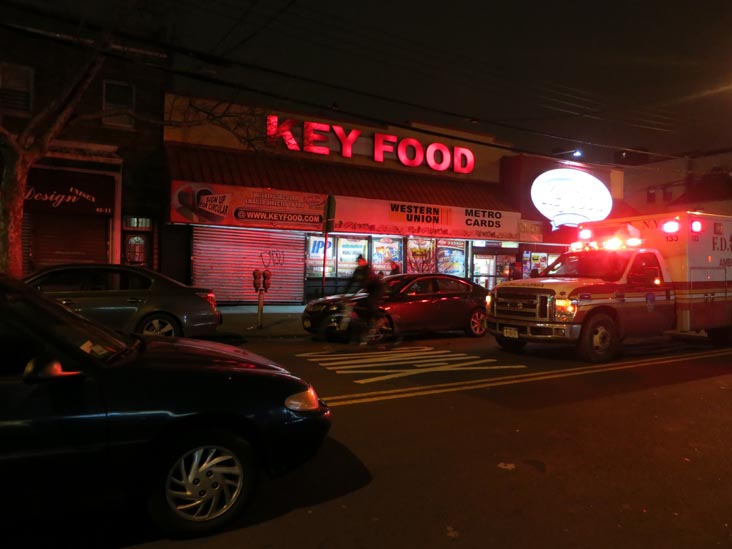
I stopped the car in the middle of the street and Goober immediately called 911. A crowd gathered around the kid, who lay on his back in the middle of the street, wailing, his shoe popped off next to him and his bicycle about thirty feet away. A lady ran to him, announcing she was an EMT. A friend of his also ran to him, announcing that the young man was a nigger who should stay awake.
"Stay still," the woman said, stabilizing the young man's head (or doing something like that; I tried not to look).
"Stay awake, nigger!" the friend yelled at the bicyclist.
Around this time, a helpful citizen (read: hipster scum) ran up — his back to Goober and myself — and began frantically asking bystanders if they witnessed the event. It took us a day or two to realize what he was doing — Why not ask us? We saw everything! — but I assume he saw a mangled bicycle and moaning kid sprawled out on the pavement and assumed that the onus would be on him to order yet another white bicycle.
Satisfied that the olive-complected young man could quickly return to delivering mediocre Thai food, Douchyclist left on the Janette Sadik-Khan he rode in on, along with most of the other people who had assembled, especially once the EMTs arrived and scooped up the kid to treat him in the truck. Eventually a police cruiser rolled up and two officers ambled out of the car.
"Nigger was speeding," the one kid helpfully pointed out to the police officer. Actually, I'm making that up, because he didn't in fact use the N-word when addressing the African-American officer, though he did suggest we were speeding.
"If he was speeding your friend would be dead," the officer intoned. The young man didn't stick around much longer.
The cops asked us what had happened, then disappeared to question the kid in the back of the ambulance.
While we were waiting, a lady walked up to ask what the kid looked like who got hit; her daughter hangs out on that corner and those kids did stupid stuff.
The cops retired to their cruiser and suddenly it was just us waiting on the street. So I killed a kid? It wasn't my fault. Goober said I seemed to be handling this well.
One of the EMTs eventually emerged from the truck. He walked over to us. "Which one of you is the driver?"
I raised my hand. He walked up to me. His eyes looked gentle, his face slightly grizzled.
"Because that kid," he continued before opening his eyes wider to unleash the kicker, "He died."
"What?" I asked, not because I didn't hear him but rather because in American English "What?" is shorthand for something along the lines of, "I don't fucking believe what you just said, and you have to repeat it just so I can have a little more time to take it all in."
"No," he quickly recovered, "I'm just kidding around with you — I'm sorry."
I assured him that this was in fact probably one of the funniest fucking moments of my entire life.
"He's fine; kids, they're springy," he added, "They're meant to be hit around a little."
"Thanks?" I sort of meekly offered.
Meanwhile, the police were finishing the paperwork, and motioned for us to get out of the street. We pulled over and waited a little while longer. The officer returned my license and the car's registration and said we were free to go. The whole thing lasted maybe twenty minutes total. It was nothing. Other than a mangled bike, the kid appeared to be fine. Nothing happened to the car.
We went right home and put Mr. Baby to bed and tuned into the Beyonce "documentary." Questions about the narrator's inherent unreliability aside, it was probably the only time on HBO I'd seen anyone unironically discuss their belief in God. We drank a cocktail.
We told our friends about the accident — Jen was nervous enough that she typed "notes" for me to use — and assured them that there was nothing we could have done, the kid was apparently OK and not dead, and as we clearly — clearly! — weren't at fault there didn't seem to be any issue that could come up about it. All of which was fine, they assured us — just go get the police report.
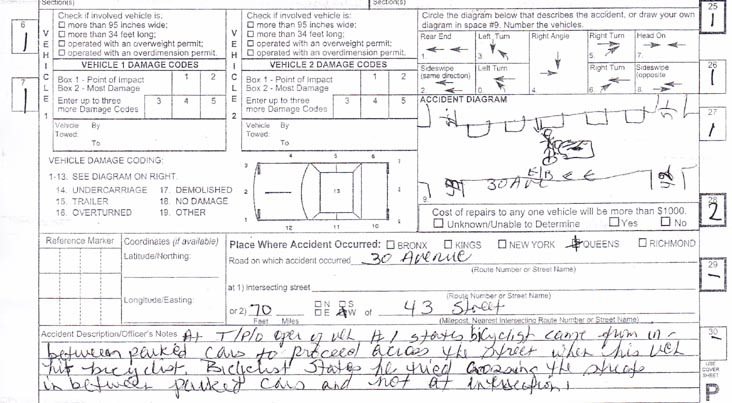
Do you know what you have to do to get a police report? It costs ten dollars. Payable via money order. This particular accident report was one page (double sided). Ten dollars. It took the clerk 45 seconds to locate and make the photocopy. Ten dollars. Ten dollars. Ten dollars.
And, to be fair, it was kind of interesting to Google Stalk the kid. I think (though I'm not sure) that I found a page with some biographical details about him. He's a church-going kid who went to the middle school Albert Shanker taught at (although his Wikipedia page doesn't confirm that — Shanker's page, not the child's). I suppose it humanized him slightly more, though I still don't understand what the fuck he was thinking (the kid, not Shanker).
About two months later my friend said that his insurance had contacted him about an accident his car was involved in. We speculated what that could possibly be about. That day an adjuster called to interview me. There's a headiness you get when you know that you can answer questions that completely truthfully. I relished this interview. I contextualized. I added details. I doubled back in case anything was somehow unclear.
A few days later another adjuster came out to look at the car. Then my friend let us know the upshot: His insurance would be paying half of the kid's hospital bills; the adjuster didn't think their premium would go up. And now you can see why the system is that fucked.
In no particular order, here's some of what I consider to be total fucking bullshit: 1) You — without lights or a helmet — ride your bike out into the street in the middle of the block and get hit by a car and your insurance only splits the difference with the insurance attached to the car that hit you; 2) Although you're as much of a moving vehicle as a car, you don't get ticketed for breaking about six traffic laws at once; 3) (This is in the form of a rhetorical statement) If Moron dickhead fuckface bicyclists demand half the roadway, they should get half the tickets, and not ticketing moron dickhead bicyclists only exacerbates a shitty situation; 4) (This is a vague statement, only somewhat germane to the above) One more fucking reason Michael Fucking Bloomberg is a total piece of shit; 5) (This is just pure ranting) I will never understand why it's somehow OK to shut down the Gowanus Fucking Expressway for a bike ride — have you seen what five miles of Sunday traffic backed up to Queens looks like? — touting the event's supposed "eco-friendliness" is ironic at best; they don't even do this for the marathon.
In the spirit of Beyonce, a prayer: God, grant me the serenity to accept a fucking asinine insurance industry which I cannot change, the "courage" and cluelessness to feel free to rant about stupid shit, and wisdom to understand that we're all kind of fucking bonehead idiots.