The Suns are playing the Jazz in about 15 minutes or so, and depending how it goes, Phoenix may be out of the playoff race.
Not that they were expected to do very well this year — the fact that they're still in the hunt with only two games left is pretty remarkable.
Besides the fact that I still root for Phoenix teams, I am rooting for Steve Nash and Grant Hill to win a NBA championship, something which neither player has accomplished. Both players seem like really wonderful, nice people, too. Grant Hill recently participated in the "Think Before You Speak" campaign. Steve Nash is into all manner of interesting, important stuff — soccer, directing films, saving children, speaking out against war. And Nash is 38 and Hill is 39, "old" for basketball but not old if you remember watching their respective college careers while you were in college yourself.
In fact, for quite some time I thought that I saw Nash in person while he played for Santa Clara. I had a distinct memory of watching him make a ridiculous number of three-point shots at the West Coast Conference tournament in 1992 while I was in school in Portland. I believed this until about a half-hour ago when I factchecked myself and discovered that Nash didn't start at Santa Clara until the 1992-93 season. The person I watched was Tomas Thompson, who played for the University of San Francisco Dons and was 8-8 for three-point goals, which was a new NCAA Division I record (since broken — see page two of this .pdf). So I was correct about something exciting happening. It just wasn't Steve Nash. Because he was still in high school then. (Tomas Thompson, in case you were wondering, seems to work as a PE teacher in San Jose now.)
My time in Portland, Oregon was limited to two "trimesters" at Lewis & Clark College. Shortly into the first "trimester," I realized that I probably made a bad choice about college. I'd tell you I realized this during an introduction to anthropology class, but I can't factcheck stuff like this, so I'd feel bad if I was mistaken. But I'll take a gamble and confirm that it was probably during intro to anthropology that I began to think that this educational experience probably wasn't worth what was being spent. I thought this because the instructor mentioned pretty early on that he taught the same class at the local community college. If you could get the same education anywhere, I reasoned, then it seemed kind of dumb to continue at a second-tier private school. Or so went my thinking.
That's not to say that the introduction to anthropology course wasn't really interesting, or that the instructor wasn't really good — it was and he was — after all, he was the one who tried to explain "culture" (and I'm probably paraphrasing) by announcing that "culture is a scam." What I think he meant by that was that culture is an arbitrary set of rules and rituals that humans impose on themselves to make order of things. It was one of those lines that seem so packed with meaning, you miss the rest of whatever someone says while you try to figure out what it could possibly mean. (Referred to — here and here — as a "Get Up and Get a Beer Line.")
Which is to say, I think it was just that this particular environment seemed too much like summer camp for me, especially back then, when I was much more earnest and probably more uptight about shit. I stuck around one more "trimester" just to be sure about my decision to leave. That was when I saw the WCC tournament on the University of Portland campus in March 1992. I had a good time that "trimester" hanging out with the Japanese foreign exchange students I dormed with, getting to see a lot of Portland and the region and seeing various shows. (I haven't been back to Portland since March 1992, which is why watching Portlandia is such a kick.)
In retrospect, attending Lewis & Clark was the best worst choice I could have made. If I had gone to Reed, I think I would have been that much more of a contrarian dickhead. If I had gone to Evergreen, it's possible I would have known Miranda July.
So I transferred to Arizona State University that fall and still graduated in four years. That made a lot more sense for me, and at that point in time, tuition only cost $1000 a semester. I think I saw that tuition is closer to $9000 a year there now. Still better than what Lewis & Clark apparently costs ($38,500 for 2011-12) or Reed ($42,800 for 2011-12) or even Evergreen ($18,978). With all due respect to people who graduated from places like these (some very close friends, even!), $42,000 a year is fucking idiotic.
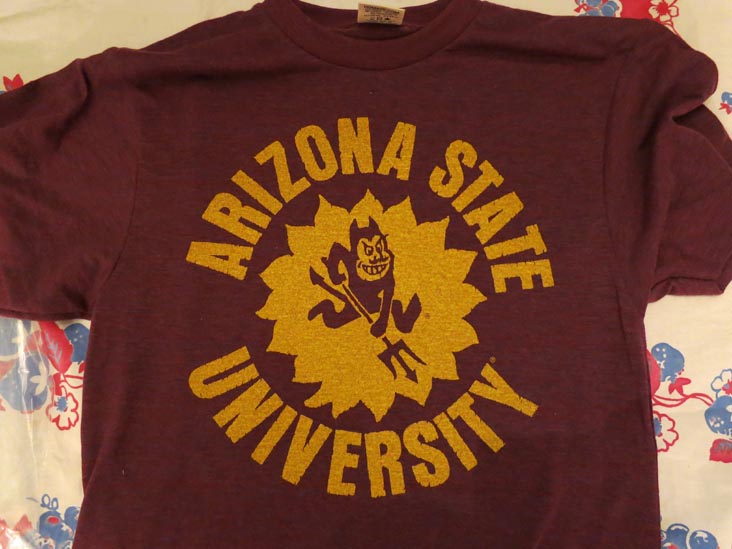
That's not to say that a liberal arts degree from Arizona State is particularly useful in a job market like, say, the New York Metropolitan Region. Which is to say, I can't believe an employer — if they cared at all — would be very impressed with ASU. The only time I ever heard of anyone registering any particular reaction was when Jen got on a subway in Lower Manhattan one day and a guy yelled at her across the train that the only thing ASU teaches you is how to suck dick. Just a little Territorial Cup humor there; this guy went to the University of Arizona. Jen liked the old Sparky logo. It looked something like this, which is a T-shirt Goober bought for me, and which I understand is now seen as a "throwback" or "vintage" look, which should depress you just as much as the idea that you were in college when Steve Nash was still in high school:
The few times I've ever had to look at resumes I avoided looking at where someone went to school.
The Suns are down in the second quarter.
From time to time I thought about what I'd do differently if I was less of an idiot at age 18, which is quite the counterfactual. And as "fun" as it sounds to go to school in a "fun" city, I don't think I'd do anything differently. If anything, I feel even more strongly about not participating in such a corrupt undergraduate system. People are correct to complain about the student loan system, but the only logical solution is to either restrict subsidized loans to public universities or not have them at all. Or what if people stopped going to expensive private schools altogether? That would be something . . .
Of course, once you get past your first shitty job or past the age of whatever or just move on and don't have to think about what a degree confers, then it kind of doesn't really matter anyway. And then once you have a child of your own, you start to freak out about making sure he or she makes it into a quality school, if not a place like Northwestern then hopefully at least a Madison or Michigan, or perhaps even UVA, because if they don't get in or don't feel comfortable in a good small private liberal arts school then there are several top-notch public options east of the Mountain Time Zone — totally kidding!! Actually, you just forget once and for all why any of it — any of it — matters in the slightest (as it were).
It's late in the third quarter and I should probably go to bed because I'll probably have to get up at some point soon and change a diaper or whatnot. Which is just as well . . .
A lot of times it seemed like the thinking was something along the lines of it was probably relatively easy to string together rhymes along to a vaguely rhythmic beat, thus rap was less important and more dismissible. This was back before the Beastie Boys were considered artists in their own right. This was back when you could "rap" by saying "My name is [blank] and I'm here to say . . ." and then rhyme something with "say" because the long "a" vowel sound is one of the laziest rhymes in the English language.
Anyway, point being, sometimes genres are deceptively simple. You never want to think that [X] medium is easy to do because that's exactly when you will realize that it's so basic, it's actually quite difficult to master. Haikus are probably like this. So is abstract art. You've probably heard someone say something along the lines of, "My four-year-old could do this!" Except not really. Except if you're talking about Ad Reinhardt, who is a freak-o charlatan creep.
Which is to say, you might find yourself reading a book, say, something along the lines of E.L. James' Fifty Shades of Grey, and say to yourself something along the lines of, "Jeez, this Mommy jerkoff fantasy genre is a fucking goldmine — we could absolutely do this!" Except that you can't. Writing something this inane is actually pretty difficult to pull off, and requires a lack of self-awareness that few actually possess.
Sometimes it's fun to read a book that is part of the cultural conversation or whatever. Sometimes it's a kick to read "trashy" things. Maybe you enjoyed Cecily von Ziegesar's Gossip Girl books. Perhaps you once killed some time on some beach or lake with something Nora Roberts shat out in a few weeks time. Maybe you snickered at the rapture porn of Left Behind. Maybe you even knew someone who got sucked into one or more of the Twilight novels.
And sometimes it's just a tedious slog through hundreds of pages of poorly written shit that you can't for the life of you see what the appeal is. It's depressing when you get to this point. Why are people reading at all? What is it about paragraphs, capitalization and punctuation that appeals to people? Why do bookshelves take up so much room in our homes? It's sort of like how Lana Del Rey sounds.
In fact, so much of Fifty Shades of Grey seems like Lana Del Rey. Fifty Shades could be the Lana Del Rey of popular fiction. Where did this come from? Why are so many of us reading it? Why are they going to make a movie out of it? It's just so fucking terrible . . .
How bad is it? For one, it suffers from that problem seemingly inherent in trashy books which is that it seems like it's a first draft. That's not the absolute worst thing, though it is a lot of what makes it such a slog to read. Who uses the word "clamber" at all, much much less 23 times in a book? It's distracting after a while. I had to look up "taciturn" because, well, I think the last time I saw it was during a SAT prep course. Then there's the Shift-F7-ness of the sex scenes: ". . . my thoughts are in riotous disarray. Wow . . . that was astounding." Or "The pressure is building slowly, inexorably inside me." Or "His breathing is mounting, his ardor . . ." Wow, hubba hubba — this could be the hottest use of the thesaurus this side of that porn site synonyms.net.
But the part that really drives home — hammers home! — the idea that it's a first draft is lines like these: "The pleasure was indescribable." Never, ever trust a writer who says something is "indescribable."
In some ways it's really cool to read a first draft. It's a straight shot into someone's mind, long before the better sense of editing or an editor comes into play. Can you imagine how interesting it'd be to see a first draft of The Corrections or Everything is Illuminated or something like that? They probably read like complete shit. I'll say this much: Those pussies hide behind "editors" and whatever. Not this lady.
In some ways you want to preserve all these quirks because they are what makes the book, or at least they are what makes the book so homespun. It's funny to read Britishisms peppered throughout the text: A "DIY" instead of a "hardware store," talk of "prams," a world where stepdads are actually distracted by MLS matches ("I call Ray, who is just about to watch the Sounders play some soccer team from Salt Lake City, so our conversation is mercifully brief"). In a way, it's kind of like the author is telegraphing that she's out of her element.
Which is useful to remember when people talk about how Fifty Shades is somehow bringing BDSM to the masses, because I'm pretty sure this is not what BDSM is about. I don't know what it's about. I don't care to know what it's about. Nothing seems more boring than tying up people and "torturing" them them with feather dusters or whatever the fuck people use. But I have a sense that BDSM isn't about men beating on women and then three-thrusting themselves to sleep. Seriously, if you omit the two or three "sexy" times when the characters "make love," the rest of it is a bunch of pound-pound-pound-squirt scenes where this carnal novice of a character somehow gets sexually satisfied. It's ridiculous. And when something is "hot," it's Q.E.D. hot, like "Why is that hot?" or "Jeez, this is hot" or "Demeaning and scary and hot" or "it's hot, freaking hot" or "He's harder, intractable . . . hot." If you say a word too much it sounds pretty ridiculous. "Hot" sounds like a bubbly moss roof or something similarly dopey. At any rate, so much of the book is "hot" because the character says it is. Which gets absurd after a while. Especially when nothing is particularly hot.
That's especially the case with the main character, Christian Grey. His only real defining features are his "molten gray" eyes. Other than that, he sounds like a real creep, who, if it weren't for his money, impressive girth and voracious appetite for breakfast, would just come off like a sanctimonious, humorless dick. But this is sort of nitpicking: Christian Grey's desirability is because the author says it is. Maybe the book is "smart" that way: "Fwachoo!" goes the whip! You will think this character is hot! Mama, so so hot!
But I guess "Christian Grey" isn't really the focus more than "Anastasia Steele" is since she's our guide into this "kinky" world. But she's also kind of unlikeable. All through the book — which, I should get out of the way right now, is just part one of a trilogy — she's complaining about how this aloof sexhound who is into BDSM and commands his submissives to sign non-disclosure agreements is somehow being less than forthcoming in their burgeoning relationship. As Angelina from the Jersey Shore once said, "Um, hello, are you fucking stupid?! They're taking their underwear off in the fucking Jacuzzi! Are you dumb? Hello!?" Or something like that.
We could go on — and on and on — but let's let it go. All of it. The product placement (who or what did Twinings have to blow to get mentioned six times in this thing?). The "long index finger" that, like Chekhov's gun, induces foreboding and fear. The ridiculous anthropomorphization of Anastasia's "subconscious" (I think she means something along the lines of "superego," but I can't quite tell for sure). The absurd elevation of WSU's Vancouver campus into some hallowed center of learning. "Charle Tango." The author's insistence on referring to a vagina as the character's "sex." "Right now, Miss Steele, I couldn't give a fuck about your food" (Location 6332 of 14900). Christian Grey "pouring" himself into Anastasia Steele. The wetness!!!! The list seems endless.
No, instead I'll close out with a couple of small points. One, the book works best when it's seen as a brutal indictment of the U.S. higher education system, degrees like "English" in general and the corrupt and decrepit intern-read-work-for-free racket that exists in the post-collegiate world. In short, Anastasia Steele is a perfect submissive because she's a high-achieving English major who has been trained for only one thing in her abbreviated life, which is to please others — specifically the world of publishing, which seems to be her one and only goal in life until Christian Grey's long index fingers come along. It's a subtle point that's lost alongside all of the groan-inducing sexalogue, but I held on to it.
Two, as a new father, I made a mental note not to spank my son lest he ends up some sort of Freudian example.
Three, and most important, Fifty Shades was originally written as as Twilight fan fiction, which underscores just how fucked up — "fifty shades of fucked up," as Anastasia Steele might say — the premise of Twilight is, and how hard it will be to walk back that whole thing. Because what's happening here is a character-for-character distillation of what that story is really about — an emotionally abusive stalker. In that sense, Fifty Shades might be the most important book of the year. Aw, fuck it — I'll just watch the movie. But it better star Matthew McConaughey, reprising his role as David Wooderson in Dazed and Confused. And maybe Zooey Deschanel as Anastasia. That lady should really be spanked. Hrm. Maybe I could get into this after all . . .
So one Sunday a few weeks back I walked outside to get the paper and noticed that one of the new hyacinths we had just planted was trampled. Of course I immediately jumped to conclusions and figured a neighborhood kid stomped on it while retrieving a ball or otherwise doing whatever it is neighborhood kids "do."
And then I noticed the paint chips.
Well, now that's odd, I thought. Where could the paint chips be coming from? So I turned around toward the house itself and saw it: Somebody stole our downspout.
Hey, wait a sec, you might say, What's a downspout? You know what they are — those pipe thingys that take rainwater from the gutter down to wherever rainwater disappears to (I think the sewer in our case, though I'm not totally sure).
And then once you figure out what a downspout is, the obvious followup is something along the lines of, What would anyone want to steal a downspout for? Good question. Though it seems hardly lucrative, apparently people steal them for scrap.
I guess the other thing is that downspouts are relatively easy to steal — after all, it's not like stealing an oil furnace or a chimney — you just rip the thing off the side of the house.
So I did what any good citizen would do: I called the cops. I reasoned that if this was part of a rash of stolen downspouts, the community needs to know about it. And if our neighborhood resembled a tweaker's savings account, then the community would need to come to terms with it: Hide your scrap metal!
So here's how it went down:
9:26: Called precinct, couldn't figure out who to call so I push "0"
9:28: Message cycles back to original recorded message; I try "1" instead
9:29: Message cycles back to original recorded message; I hang up
9:31: Call 311
9:32: 311 transfers me to a 911 operator, which is exactly what I don't want to do since this is clearly not an emergency
9:35: 911 sends a message saying something along the lines of an officer is assigned to the case and since they're extremely busy, there may be a delay responding to my call
9:51: Cops arrive
10:10: We finish marveling at the strange event with the neighbors and return inside
Which is to say, I guess with all the bad press about the NYPD sweeping crime under the rug or whatnot, I sort of expected some kind of "911 Is A Joke" response, but that totally didn't happen.
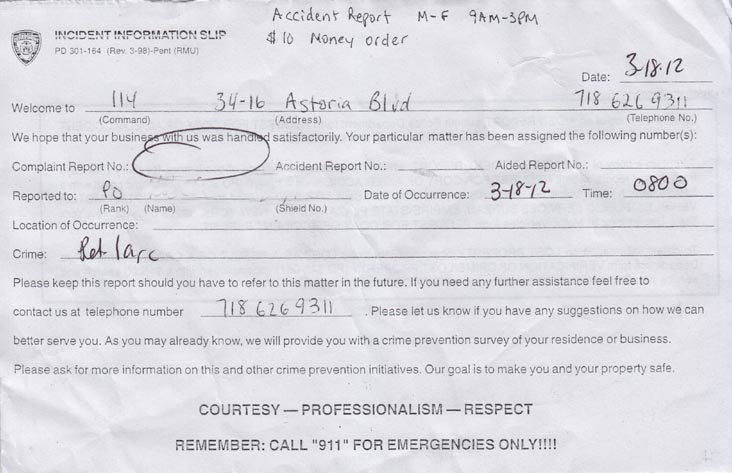
What did happen is that a squad car showed up within 15 minutes and two pleasant officers took the complaint. After I looked at the Incident Information Slip and realized there was no complaint number — actually, I seemed to remember the officer circling the blank spot and telling me I needed to call to get it later. I wondered if they would just fill out this slip and let the crime go unreported, so I called today. And . . . there's actually a complaint number. Not sure what this means, but I suppose it means that the crime has become part of the statistics for the neighborhood.
Another goal of mine was to make it into the police blotter of one of the local weeklies. As far as I know, this did not happen.
When the cops showed up, several of the neighbors came out to see what was going on. Everyone was surprised that a downspout was allegedly stolen, including the cops, who sort of seemed like they wanted to make sure this was an actual theft before making a report.
Part of me wanted the entire street to have their downspouts stolen. There's something about the idea of a shared experience that somehow lessens the sting. It's stupid of course.
About a week later I was walking to the bagel store on a weekend morning and saw a downspout ignominiously discarded on the side of the road about a block from the house. It had been folded in at least three directions. This made me wonder whether we were victims of weekend vandals, which is obviously not nearly as exciting as scrap metal thieves.
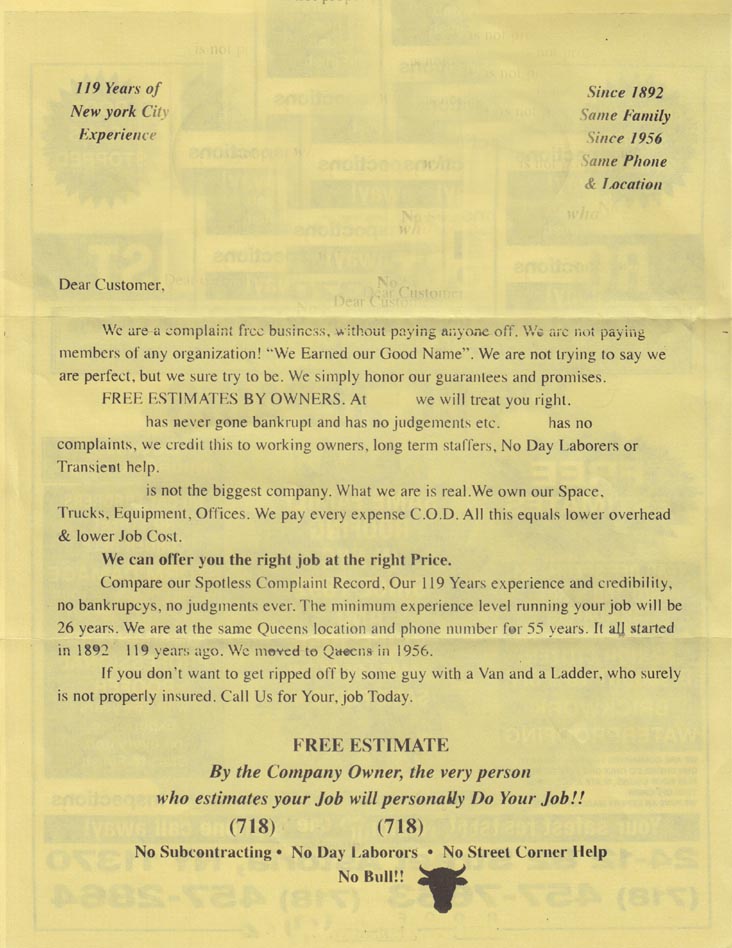
A few weeks after that we saw this flier on the door, which solved an immediate problem — how to replace the missing downspout — but which also seemed a little too . . . perfect — timingwise, at least:
Now I'm not for a second intimating that this company made our downspout disappear. Not at all. What I will say is that there's not a chance in hell that I'd ever contact this company. Not because I think they did it — not at all! — but because if they did it, there was no way I'd want to use them. I remember reading about this a while back with some car windows on Staten Island, so it was just this company's dumb luck that they handed out a flier to us so soon after the incident.
Then, as Goober pointed out, there was the issue of the wording of the note.
One thing I think companies should never do is focus on the negative. The first thing they say is they're a "complaint free business, without paying anyone off." Dude, that's your open? You have to do a little better than that. Same paragraph: "We are not trying to say we are perfect, but we sure try to be." I appreciate the candor, but as a prospective customer, I'd like to think that you're imperfect with others and not me. Just a little psychology or whatnot.
Paragraph three: They've never gone bankrupt. To paraphrase Chris Rock, You're not supposed to go bankrupt!
Paragraph four: "What we are is real," like this is the Penthouse Letters of gutter repair.
I don't know, they seem like they're trying a little too hard. We're still trying to figure out who to call to fix the thing. I'll let you know if we come across anyone good.