Slightest pal The Threshold passed along this link about the latest Kings of Leon album "dropping" ("dropping" being a term long associated with the band) that contains this bombastic nugget:
"I hate fucking hipsters. Everyone talks about indie this and indie that, but would you really want to be one of those indie bands that makes two albums and disappears? That's just sad . . . When we signed on with our manager, we all said we wanted to have a box-set career. We'll gladly be the next generation of bands that aren't going anywhere."
Set aside the snipe at "hipsters" for a minute — because if hipsters didn't exist, entities like Kings of Leon would have to invent them. What really stuck out is the Clinton-esque "place in history" notion of a box-set career. Maybe I'm being too Andy Rooney here, but since when did "rock bands" look forward to a box-set career? Maybe it's Rolling Stone's fault. Maybe it's LeBron's fault. Maybe it's a lot of things' fault that don't immediately and conveniently roll off the tongue, but the notion of a band positioning itself in advance to look forward to its induction into the Rock n' Roll Hall of Fame seems a little . . . unseemly.
That's all OK though — we all like to dream. Who hasn't hit the game-winning free throw in his or her driveway? Who hasn't already composed his or her own Oscar acceptance speech? But if the Kings of Leon ever put out a box set, I hope they call it "Gift Down Below: Best Of KoL, 1999-2014" (2014 seems like a pretty good time to go out on top, no?).
Why "Gift Down Below"?
Threshold is an inveterate KoL fan. Maybe it's the soaring hooks. Maybe it's the ruggedly good looks. Maybe it's just the skinny jeans. But one song on the band's 2008 album Only by the Night stuck out like a sore thumb for her, and it wasn't the absurdly dopey "Sex on Fire" (incidentally, also one of Jayson Werth's walk-up songs last season). It's "I Want You," track 9 — one of those box-set omissions that sort of fill up the last quarter of an album.
Threshold noticed some strange lyrics about two-thirds of the way through the song, and upon further review, determined that these were the lines:
Homeboy's so proud — he finally got the video proof
The night vision shows she was only ducking the truth
It's heavy I know — black guy with a gift down below
A choke and a gag — she spit up and came back for more
Well, OK then! This verse fueled a long car-ride parsing the possible meaning. First we wanted to know who actually writes that kind of lyric. Some of us allowed that maybe he was a storyteller kind of, you know, creating a character or something and eventually we reached a sort of consensus — "I Want You" was a small-town tale of thwarted teenage love, sort of Norman Rockwell meets Cheaters.
And yet. And yet. There's still that lyric.
Now YouTube is good for many things, not least of which being Kings of Leon covers played by enthusiastic amateurs. A year ago I found a bunch of covers "I Want You," including one by a young woman who could barely bring herself to sing that last verse. She has since taken down the video. Another, however — sung by a duo for whom English does not appear to be their first language — persists online (the verse comes in at about 2:30):
This is the band itself playing the song live in 2008 (again, the verse comes in at about 2:30):
Like I said, weird. Weird that lead singer Caleb Followill doesn't really flinch when he sings those lines.
So, "place in history" — the confounding thing about worrying about one's place in history — especially in pop music — is that people are so often wrong about it. Yes, there have been some wonderful reappreciations of bands over the years, but the kind of stuff that would make the Hall of Fame seems kind of catch-as-catch-can.
One of my favorite examples is Bob Seger, or at least New York Times critic John Rockwell's perceptions of Bob Seger way back when. Today, Seger is probably best known for single-handedly, self-consciously jumpstarting the classic rock genre — "Old Time Rock and Roll" is as curmudgeonly as it gets, and it's 1978 release year seems a little premature (Caleb Followill, just so you know, was born in 1982) to be perseverating on existential threats to the genre.
Anyway, Rockwell, who last served at the Times as its dance critic, acknowledged in his December 26, 1976 year-end rock music wrapup (.pdf at the link) that "[t]he most interesting of all the trends one could discern was the growing, world-wide interest in 'punk rock.'" And while there were some examples he picks out that turned out to look fairly good in retrospect, he kind of misses the boat in general:
New York's punk-rockers tend to be mixed up with a self-conscious conceptual artiness (Patti Smith, Talking Heads, the Ramones) which has its genuine charms but which sometimes takes the music and the image rather far from punk primitivism. Closer really to the true punk-rock spirit are such midwestern perennials as Bob Seger, who himself made an appealing bid for a nationwide appreciation with a fine live album and an even finer studio album in 1976.
The Future Of The Kingdom
So where does that leave us? Brother Michael insists that Kings of Leon are the Eddie Money of this generation. I appreciate that but I think that they're really more like .38 Special (think "Hold On Loosely"). This may sound like nitpicking, but I'm less interested in bands that work with talented producers than I am fascinated by bands that have their own unique take on their sound — perhaps you could sneer at the latter with a slur like "indie".
Let's investigate "Use Somebody," the band's best-known hit. It's well crafted in the way that Hillary Duff's "Come Clean" is well crafted, but there's something that leaves me cold about the song — that and the concept of "using someone like you" reminds me of George Peppard assembling the A-Team.
Chad Kroeger turns the gain up so much on the three stories of amplifiers — dig that chunk-chunk-chunk-chunk-chunk-chunk! guitar sound — that it sucks any "subtlety" right out of the song — he does yeoman's work in splitting the thing open and exposing it for the fluff it is . . .
Don't get me wrong, I'll gladly purchase the future Kings of Leon box set for all manner of loved ones — but just as long as their producers comply with my title request, and just as long as "I Want You" is the first track on disc three.
I should say "here's how you could have had spent six hours" since the exhibition just closed, but you get the idea . . .
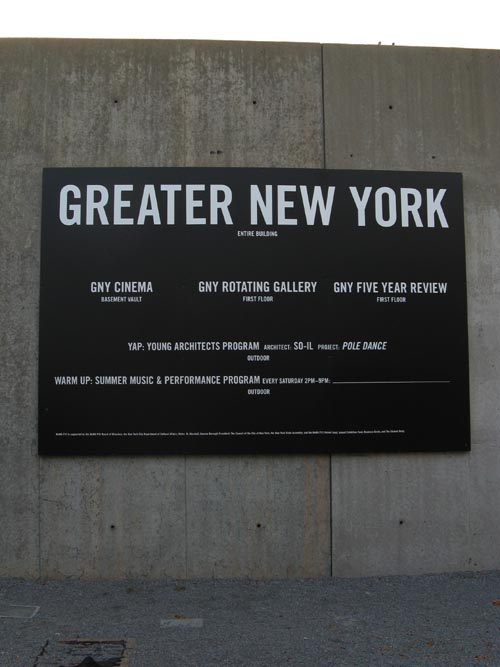
I took Mom and Dad to the Greater New York show because they had never seen PS1 before and because the show is/was pretty good — Jen and I spent a couple of hours there the week before and there were some interesting pieces.
And while I remembered that there were some longer video installations, I don't think the fact of just how long they were really sunk in until I walked through the exhibition with Mom, who began the afternoon by dutifully watching Deville Cohen's 18-minute-long "Grayscale (A Video in Three Acts)" in its entirety. This isn't to say that "Grayscale" isn't interesting — it is! — I liked, for example, how Cohen used office supplies to create props and a set for the video — that was cool. It's just that I think I "got" what was going on by only sitting through the last half of the third act — maybe five minutes instead of the full 18. Or not . . .
This is when it occurred to me that if you sit through the entirety of all of the video installations, you could spend a long, long time at PS1. Which is how I got the idea to count the all the minutes listed in the placard information — it turns out that there were five hours, twenty minutes and seventeen seconds of video installations. This doesn't even include the Alex Hubbard, Leigh Ledare, Rashaad Newsome and Sharon Hayes installations, which didn't have times listed but which probably added at least another half hour to the total (nor does it include the GNY 5 Year Review, which had probably about two more hours of video in a separate gallery). Which is to say, if you were to have visited the Greater New York Show, it would take you six hours just to view the video installations:
Lucy Raven (1) (51:30)
Lucy Raven (2) (10:40)
Kalup Linzy (52:55)
Alex Hubbard (no time listed)
Emily Roysdon (7:51)
Deville Cohen (18:00)
Leidy Churchman (1) (20:00)
Leidy Churchman (2) (20:00)
DETEXT (3:30)
Conrad Ventur (4:00)
Rashaad Newsome (no time listed)
Brody Condon (1) (20:00)
Brody Condon (2) (7:00)
Ryan McNamara (5:11)
Gilad Ratman (8:11)
Tommy Hartung (15:36)
Elisabeth Subrin (6:00)
Liz Magic Laser (22:00)
robbinschilds (6:45)
Dani Leventhal (16:00)
Maria Petschnig (20:00)
LaToya Ruby Frazier (3:26)
Tala Madani (1) (0:34)
Tala Madani (2) (0:45)
Tala Madani (3) (0:23)
Leigh Ledare (1) (no time listed)
Leigh Ledare (2) (no time listed)
Sharon Hayes (no time listed)
Now PS1 is only open from 12 to 6. And since I don't think the curators intended for you to visit the exhibition over the course of several days, I guess it's important to assume that maybe — maybe? — the artists didn't intend for you to view the entirety of each piece. I have a hard time believing this, however, because for every piece like Brody Condon's "20die" — seven minutes of someone shaking a 20-sided die in a glass — there is something like the Deville Cohen piece, which has a sort of narrative. Or the four-episode, 52-plus-minute Kalup Linzy videos. Or Liz Magic Laser's 22 minutes of playing with a da Vinci Surgical System (which was actually quite entertaining). Then there is the 16-minute-long Dani Leventhal installation, which seems to have a narrative as well, though it's not clear whether it's OK to drop in and out of it.
Then you think that if you do happen to drop in and out of a video installation, are you also missing the point? You wouldn't start watching "24" eight hours into the season, then just go back and watch the stuff you missed. So then there's the issue of hitting the pieces at their beginning. At least one of the pieces — one of the best pieces, in my mind — actually plays on this idea: Elisabeth Subrin's "Lost Tribes and Promised Lands" starts with two images side by side of the same Williamsburg streetscape. In general they are the same spot but it's clear from different clues — the same billboard in the background is advertising something different, for example — that they were taken at two different dates. If you started in the middle of the piece it takes a while to figure out what is different and your preconceptions take over — maybe it's showing gentrification or who knows . . . but eventually you notice that the through-line in all of the images is the American flag, and when you finally get to the beginning of the piece, Subrin "reveals" what's going on — the two films were taken on the same Saturday in October, one in 2001 and one in 2008. So of course it's really showing the images of patriotism and how those expressions (mostly) faded seven years after 2001. One of the best sets has a vinyl-sided house on the earlier side with an American flag and an Italian flag hanging there (this is Columbus Day weekend); the later side only has the Italian flag.
Subrin's piece is brilliant on a lot of levels. One, as a historical piece — you may have forgotten about all those Osama bin Laden posters in the bodega windows — and it's interesting to see the gentrification subtext that is in there (I think). Two, it expresses in that dull summer-to-fall way that things sort of peter out in a stubbornly silent way (OK, that's my interpretation). And three, it takes advantage of and actually encourages you to drop in the installation in the middle, because it makes the experience is that much better. Four, it's only six minutes versus, say, 52 minutes . . .
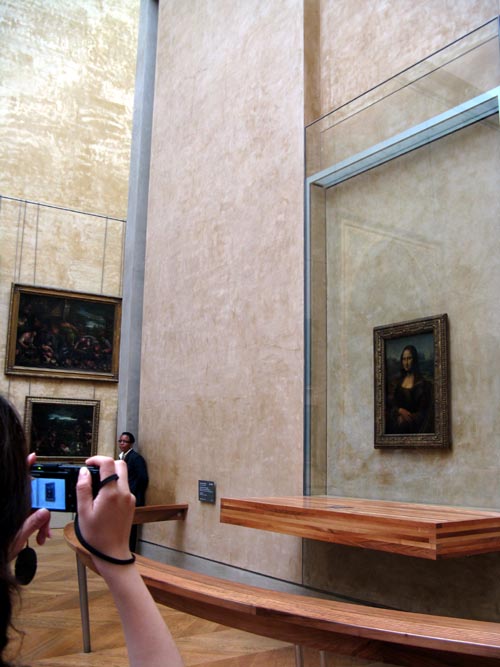
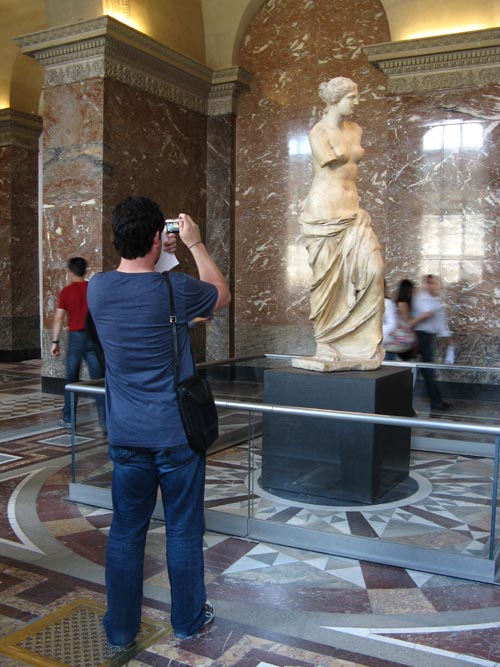
So yeah, the mind reels at how long you could spend — which brings up the topic of the rest of the works in the show — the "untimed" art, as it were. Dad mentioned afterward that he had been told by people that the average time someone spends in front of a painting is four seconds. I think this comes from Blake Gopnik's article in the Washington Post back in 2001 where he sat down at the Alberto Giacometti MoMA exhibit and timed how long someone read the explanatory text (50 seconds on average) versus actually looking at the piece (in his estimation, an average of four seconds). As someone who frequently spends only about four seconds in front of a painting, this doesn't surprise me. And during the Greater New York show, there were probably very few "untimed" works that I spent more than, say, four seconds in front of (if that — a lot of time I probably just cruised by some stuff). Maybe video art is a way of recapturing some of that attention deficit . . .
In 2009 the Times' Michael Kimmelman expanded on Gopnik's observation and also added the digital camera dimension — basically that digital cameras have taken the place of sketchbooks. But I think that digital cameras at least provide a way of interacting with art on a tiny bit of a deeper level. Plus, it's funny looking:
Like I said, I'm not above cruising by an untimed work of art. I accept that this image, for example, only requires a modicum of attention:
While this video of the same thing may (or may not) mesmerize you for the full 8-plus minutes:
They're the same "idea" — I get that — though maybe part of the middle there might have been OK to edit out — but there's something to the idea that if I give you something eight minutes long you might feel compelled to watch the whole eight minutes. No one tells you when to drop in or out.
Mom will say that she didn't sit through all of the video pieces — elsewhere on the first floor she only watched a few minutes of Lucy Raven's one hour, one minute and ten seconds of video (two separate components of one of the gallery spaces) — but it certainly seemed like we spent a lot of time on the video installations. And obviously it made me wonder . . .
There's something sad about a blog post titled "This Blog's Final Post", which is what just happened with The New York Times' Idea of the Day blog. You can see on the comments that many of its regular readers will miss it — they're saying stuff like "tragedy" or "I miss it already" or even the simple "thanks to everyone who worked on this enlightening enterprise." I had the Idea of the Day on my own reader and it was one of the easier blogs to manage — one post a day, and generally you got the gist without even having to click through. I guess that's not a great model for a blog's success, but at least it wasn't a "mark all as read" type of feed.
Blogs are different from bands in that bands can put out a last album and let it go off into the sunset. The band Big Black, for example, knew it was going to break up after its last album. In the liner notes they wrote that "breaking up is an idea that has occurred to far too few groups, sometimes to the wrong ones." In interviews during their final tour they said that they wanted to break up before they started to suck.
The worst kind of blog death is a slow death, with a final post that isn't really a send off or a final post of any sort but rather something that stays stuck in time kind of waiting for another post to happen. Maybe you go to the site every once in a while to see if they didn't just change their feed address or something, but it was just abandoned.
It's worse when the blogger dies — there are examples I've heard about and here's one that comes to mind but fortunately blogging is still pretty new, so it doesn't seem to happen all that often. (And what happens when you die? Someone pulls your domain out from under you.) The idea of suddenly expiring without a "final post" haunts me — it would be horrifying to have your last thoughts on earth be something snarky about how the mayor wants to ban salt. (Here's Guskind's last post, by the way — a picture of a pleather sofa . . . with a typo in there — insult to injury.)
Idea of the Day's Tom Kuntz avoids this worst-case scenario by signing off succinctly: "The blog's end is a result of limited resources in a medium where any number of worthy projects are possible, and where new priorities continually emerge." Fair enough, understandable — I've been a part of more than one blog that kind of peters out for similar reasons — but the way blogs kind of sit there in perpetuity just waiting to be updated is depressing — not depressing in, say, the way Srebrenica was depressing but more in the way C.J. Wilson not blogging is depressing; put plainly, C.J. Wilson is the kind of baseball player that is best seen and heard (and I'm sad that his MySpace page is now set to "private").
Yes, C.J. Tweets, but I've never liked/been skeptical about Twitter. One, it's important to control your own content. Two, why only 140 characters? Lame.
On Why C.J. Wilson Is Great
One, C.J. Wilson is the living embodiment of Mark Harris' Henry Wiggen character — the book-writing pitcher in Harris' baseball novels. I should add that Wilson is much more articulate — and way more straight edge. Two, like Wiggen the character, Wilson is also a great player — and how many awesome pitchers also studied screenwriting?
But let's go back to the straight edge part — in the era of Roger Clemens and Mark McGwire, a Major League Baseball player proclaiming a straight edge lifestyle carries a significance that goes way beyond the typical don't drink-don't smoke-don't fuck connotation. That is cool. No, it's great. And — in my best haughty adult-something voice — it's also important — not so much for the kids (though that's important, too) but for anyone who watches baseball.
Wikipedia C.J. — he's interesting. And if the Rangers make it past the Yankees, you'll be one up on Joe Buck.
Oh, And By The Way, Here's An Abbreviated Appreciation Of MLB Extra Innings That I Meant To Write But Didn't
I came across C.J. Wilson this year while watching the Texas Rangers' feed on MLB Extra Innings. If I had had it together, I would have also written an appreciation of MLB Extra Innings — watching the local feeds is a lot of fun for all the local commercials. You might not have realized, for example, that the Rockies' Troy Tulowitzki was growing a mullet this year for charity. If you had the Rockies' local feed, you'd know this — over and over and over, in fact. This local color made midweek Royals-Mariners day games that much more exciting. If you're a fan of baseball and have the time and inclination to sit through more Brewers-Pirates matchups than you could ever dream of, I highly recommend the service.